

World ties its hottest month on record as July heat sweeps three continents
The planet has just endured its joint-hottest month in 176 years of record-keeping, as searing July heat handed North America, Africa and Asia their warmest month ever.
July 2026 tied with July 2024 as the hottest July since global records began in 1850, the US National Oceanic and Atmospheric Administration (NOAA) reported on August 11, with global surface temperatures running 1.18C above the twentieth-century average.
The rankings split by dataset: NASA rated July 2026 the hottest July outright, while Copernicus and the World Meteorological Organization placed it second, 1.47C above the pre-industrial average. Either way, the four warmest Julys on the books are now the past four.
July is climatologically the warmest month of the year, which makes the two tied Julys, on NOAA's reckoning, “more likely than not the hottest months on record for the globe since 1850”.
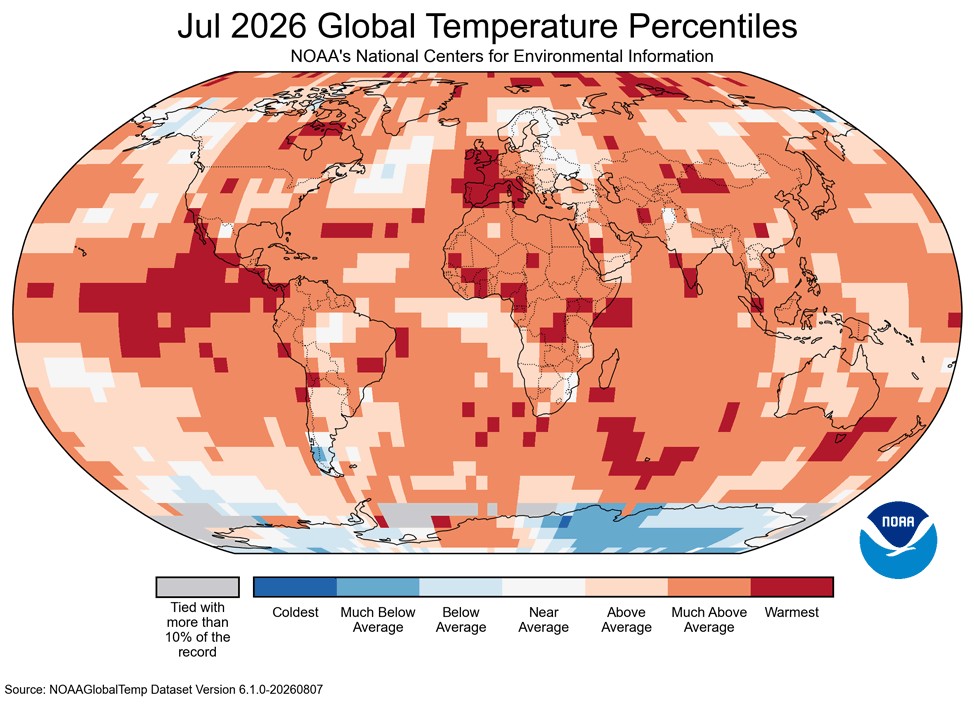
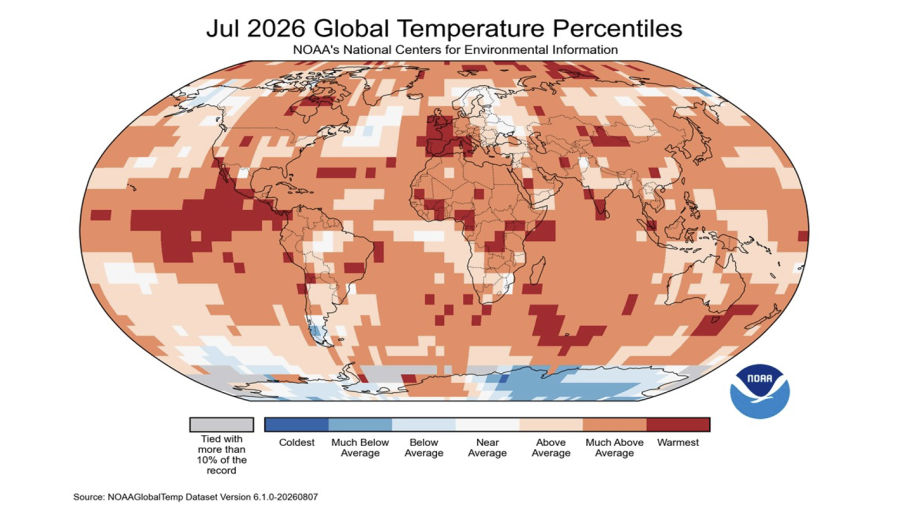
Figure 1. Departure of July 2026 temperatures from the 1991-2020 average. Record warmth (dark red) stretched across western Europe, the Americas, Africa, Asia and the Arctic; only a small part of Antarctica ran cold. Image credit: NOAA/NCEI
The oceans did the heavy lifting. Global sea-surface temperatures set a July record, running 1.02C above average – the first July past that mark – as the daily reading for the 60°S-60°N band closed the month at 21.05C, a hair behind the all-time high set in March 2024.
Behind the heat sits a strengthening El Niño. NOAA puts near-certain odds on the event lasting into February 2027, with temperatures in the benchmark Niño 3.4 region already 1.8C above average and edging towards the 2C mark that defines a “super” El Niño. A record-strong event layered on the warming trend could yet tip 2026 or 2027 into all-time-hottest-year territory.
Europe managed only its seventh-warmest July as a whole, yet western Europe lived through its hottest June-July on record. Late-June heat had already handed Hungary its hottest day on record and pushed Poland past 40C for the first time. Seventeen countries or territories beat or tied an all-time heat record over the period; the Northern Hemisphere's top reading was 52.7C at Omidieh, Iran, on July 14.
The United States, meanwhile, logged its hottest month in recorded history, eclipsing the Dust Bowl peak of 1936. Insurance broker Gallagher Re counted 29 billion-dollar weather disasters worldwide in 1H26, at a cost of $104bn – which it called a “manageable start”, still short of the $139bn decade average.
The bill is mounting all the same: extreme heat could cost Europe's economy €800bn by 2030, insurer Allianz has warned. At the poles, Arctic sea-ice cover shrank to its sixth-lowest July extent in the 48-year satellite record and Antarctic ice to its fifth-lowest. Across the month at least 250 weather stations with data back to 1980 set – not merely tied – an all-time heat record, on a tally by records tracker Maximiliano Herrera published in Yale Climate Connections.
Follow us online