


Australia's giant battery fleet has killed the evening price spike

For decades, the economics of electricity markets around the world have been governed by a simple and expensive daily ritual: as the sun goes down, solar generation drops, demand rises, and coal- and gas-fired plants switch on to fill the gap — setting prices at their most punishing precisely when households demand the most power.
Thanks to its large and growing battery storage capacity, Australia is close to completing the transition to green energy and squashing the evening price spike.
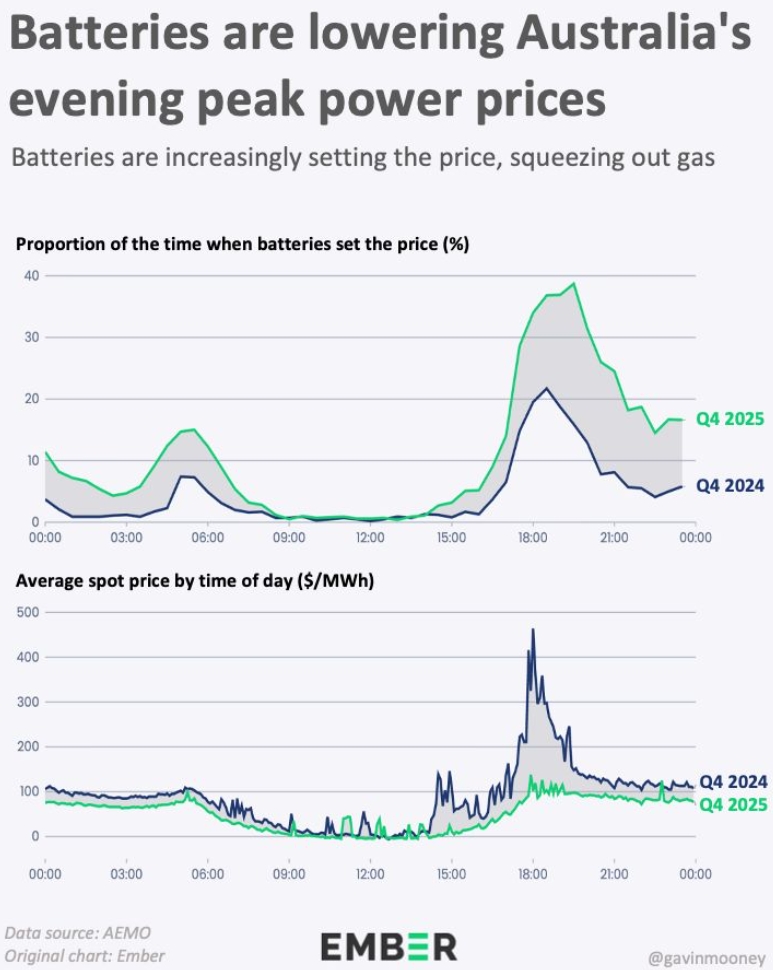
New data from the Australian Energy Market Operator, visualised by energy think tank Ember, captures the transformation with unusual clarity. In the fourth quarter of 2024, wholesale electricity prices in Australia's National Electricity Market spiked to nearly $500 per megawatt-hour during the early evening peak — a familiar pattern driven by gas peakers pricing the market at the margin.
By the fourth quarter 2025, that spike had almost entirely disappeared. Evening peak prices averaged closer to $100/MWh — less than a quarter of the previous year's levels. The curve that once reared dramatically upward between 17:00 and 20:00 is now almost flat.
The mechanism behind the change is straightforward. Batteries charge during the middle of the day, when Australia's extraordinary rooftop solar penetration drives wholesale prices toward zero or below. They then discharge precisely at the 18:00 peak, undercutting the gas plants that previously owned that hour. Batteries were setting the marginal electricity price nearly 40% of the time during the evening peak in the fourth quarter 2025, up from less than 5% a year earlier, according to AEMO data. The gas peaker, for decades the defining technology of evening electricity pricing, is being structurally displaced.
A fleet that tripled its load-shifting in a year
Battery energy storage systems in the NEM more than tripled their daytime-to-evening energy shifting in the first quarter of 2026, according to AEMO's latest Quarterly Energy Dynamics report. Average battery discharge reached 359MW during the quarter — more than three times the 98MW recorded in the first quarter 2025.
This growth was driven by 4,445MW of new large-scale battery storage systems, adding 11,219MWh to the grid since the end of the first quarter 2025, more than doubling total installed battery storage in the NEM. Total installed battery storage, including commissioned and commissioning assets, exceeded 8,000MW by the end of the quarter.
Battery discharge reduced dispatch requirements for gas-fired generation during high-demand periods, with gas-fired generation recording its lowest average for any quarter since the fourth quarter 1999, at 712MW — 24% lower than in the first quarter 2025.
Battery storage set prices in 32% of trading intervals across the NEM during the quarter, displacing hydro as the most frequent price-setting technology. The NEM average wholesale spot price averaged AU$73/MWh, down 12% from the first quarter 2025.
The projects behind these numbers include the 415MW/1,660MWh Orana BESS in New South Wales, the 300MW/650MWh Mortlake BESS in Victoria, and the 260MW/1,090MWh Supernode BESS unit 2 in Queensland — all commissioned in the first quarter 2026.
The largest single project to date is the 600MW/1.6GWh Melbourne Renewable Energy Hub, developed jointly by Singapore-based Equis's Australian subsidiary and the Victorian government's State Electricity Commission, using Tesla (NASDAQ: TSLA) Megapack units.
The world's most battery-dense economy
Australia is the world leader in the unfolding battery revolution and the first nation to surpass 1 GWh of utility battery capacity per million people — far ahead of China and the US, each with less than 400 MWh per million people. Australia is now the third-largest market worldwide for large-scale battery energy storage by capacity, with 14GW and 37GWh of capacity at or nearing financial close.
In 2025, Australia commissioned 4.9GWh of grid-scale batteries — matching the entire cumulative output from 2017 to 2024 combined.
The pipeline shows no sign of slowing. Standalone battery storage connections in the NEM increased from 20.5GW to 33.2GW over the past year, with battery storage now comprising 49% of the total 67.3GW of projects progressing through the grid connection process.
Around 74% of battery projects in the pipeline feature grid-forming inverters, which can provide essential system services and maintain grid stability as coal-fired generation continues to decline.
In December 2025, Canberra announced it would expand the Cheaper Home Batteries Program from AU$2.3bn to AU$7.2bn over four years, targeting more than 2mn additional residential battery installations by 2030 and approximately 40GWh of additional storage capacity. Battery storage costs fell between 11 and 16% in 2024-25 according to CSIRO's GenCost report, while large gas open-cycle plant costs rose 32% over the same period.
Renewables supplied 46.5% of NEM generation in the first quarter 2026 — the highest share on record for a first quarter. South Australia set a new record on January 31, reaching 98.8% renewable energy generation and storage contribution during a single half-hour interval.
The gap that remains
The transformation is real but unevenly distributed, and the demands on storage are growing faster than the build. New South Wales has been warned that 75% of its 56GWh storage requirement for 2030 has not yet reached a financial investment decision.
"Two years ago, we needed 40GWh of storage operational by 2030. That has now increased to 56GWh solely due to solar penetration," said Paul Peters, chief executive of the NSW Energy Security Corporation. "Of the 56GWh needed, 12.5GWh has hit the financial investment decision. 75% of what we need in 2030 is not there today."
The more rooftop solar Australia installs — and with nearly one in three homes now carrying panels, the penetration is already deep — the more storage is needed to absorb it and shift it to the evening. The battery is solving the solar problem, and solar is making the problem bigger. The race is on between the battery capacity build-out and the solar panel deployment.
For the rest of the world, Australia provides proof, at scale, that the gas peak can be displaced not theoretically but in practice — in a real market, with real prices, across a real winter.
Follow us online