
Eight-hours grid-level battery capacity will complete the green energy revolution

What started as development banks pushing emerging markets to adopt green energy for reasons of sustainability and the Climate Crisis has been transformed after the cost of producing green energy plummeted. Today it is a simple economic argument: there is no source of power cheaper than solar and wind.
Now a second revolution is underway. The explosion of renewables is a boon, but it didn’t solve the basic problem with renewables: covering the baseload demand. Solar only generates power when the sun is shining and wind power when the wind is blowing. They don’t produce anything after dark on calm days when demand typically is highest.
Like renewables, that problem has now been solved too, as the cost of system-scale batteries has also plummeted. Massive battery arrays have increasingly been added to green generation projects. But while solar generating capacity increasingly can meet peak demand, the battery revolution roll out is lagging behind. Batteries can typically cover 1-, 2- and 4-hours of demand, but that still leaves the need for things like gas powered power stations to cover the peak periods when renewables are offline. As a result, gas powered electricity is still setting the prices of power.
What is needed is a battery array that can cover 8-hours of demand and cover all the baseload demand. That would be a game changer. The 8-hour battery means renewables can cover the baseload demand in the peak demand dark and still periods. Taking the gas powered swing demand providers out of the loop means the cost of power would plunge again and end the reliance on fossil fuels like gas completely.
So far, there are relatively few examples of countries or regions that have crossed this line, but the first ones are beginning to appear. The solar-rich South Australia region is now producing 200% of its electricity demand from just solar power, partly thanks to having the highest roof-top panel penetration in the world and is talking about making power free during the daytime. Parts of Texas and California are also close to covering all their energy needs with renewables.
The global grid is currently producing a total of 8 TWh of power, of which around 4.5 TWh is renewables, but total global battery storage capacity is roughly 2 TWh of installed capacity. At least another 6 TWh needs to be installed to allow renewables to take over the job of powering everything – and probably a lot more as storage also has to take account of the fluctuations in demand, requiring significant redundancy in the system.
The IEA says as battery costs continue to fall a large pipeline of announced projects is set to meet a global goal of tripling renewable energy capacity by 2030, and global energy storage capacity needs to increase sixfold by 2030.
Battery deployments
China has emerged as the global green energy champion. Half of all the solar panels in the world today are in China. It has also pioneered the development and production of batteries.
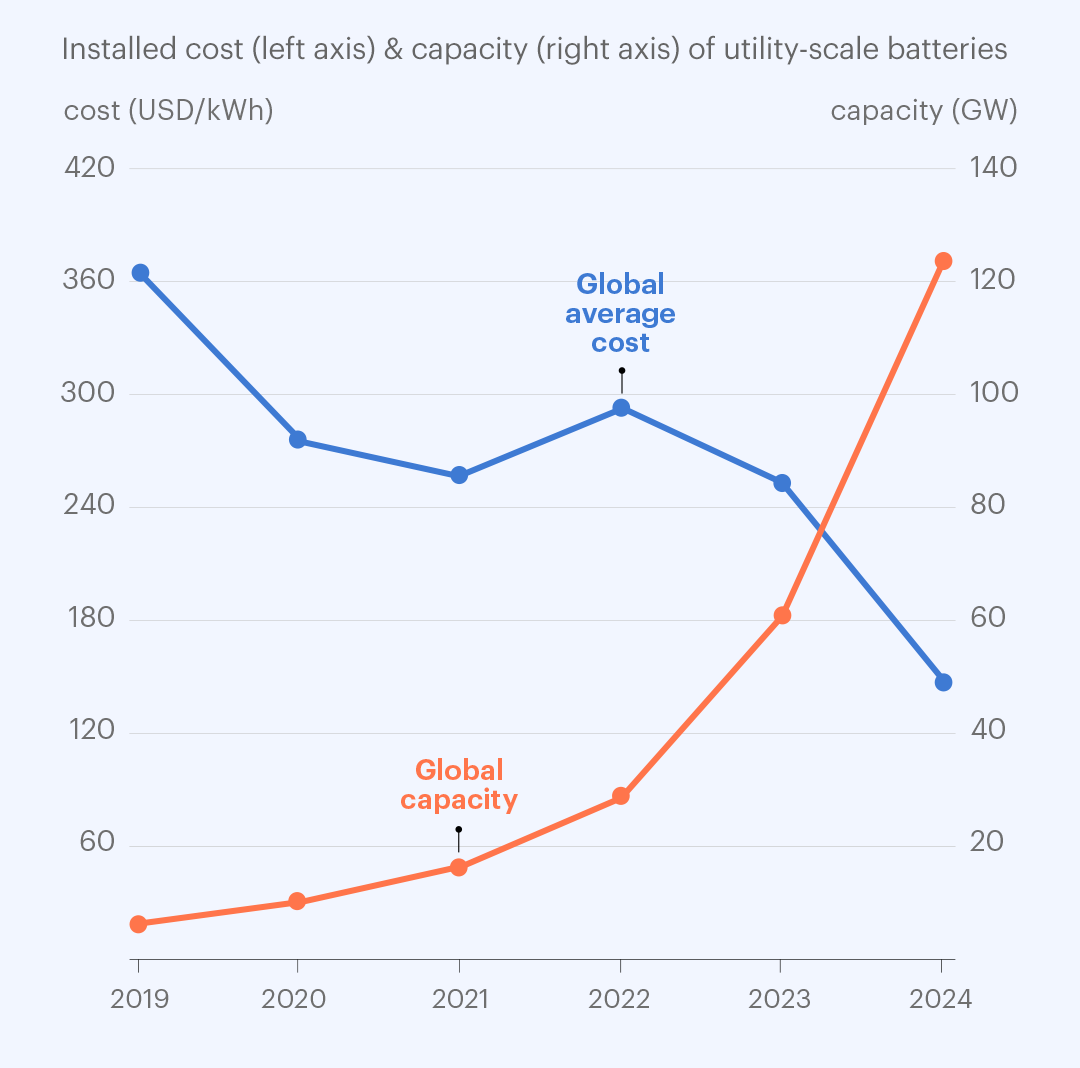
Battery deployments are set to increase to 70 gigawatt-hours in 2026, compared to 58 gigawatt-hours installed in 2025, according to a report by the Solar Energy Industries Association and market research firm Benchmark Mineral Intelligence Ltd.
By 2030, the market is forecast to exceed 110 gigawatt-hours, the report said. The trade group’s forecast is more bullish than one released in October by BloombergNEF, which sees battery installs rising to nearly 48 gigawatt-hours in 2026 and 80.6 gigawatt-hours by 2030.
The cost of standalone four-hour battery projects declined 27% in 2025 from a year earlier to $78 per megawatt-hour and is expected to fall to $58 per megawatt-hour by 2035, BloombergNEF reports. By 2035, cost could fall by another 30% for solar, 25% for battery storage, 23% for onshore wind and 20% for offshore wind.
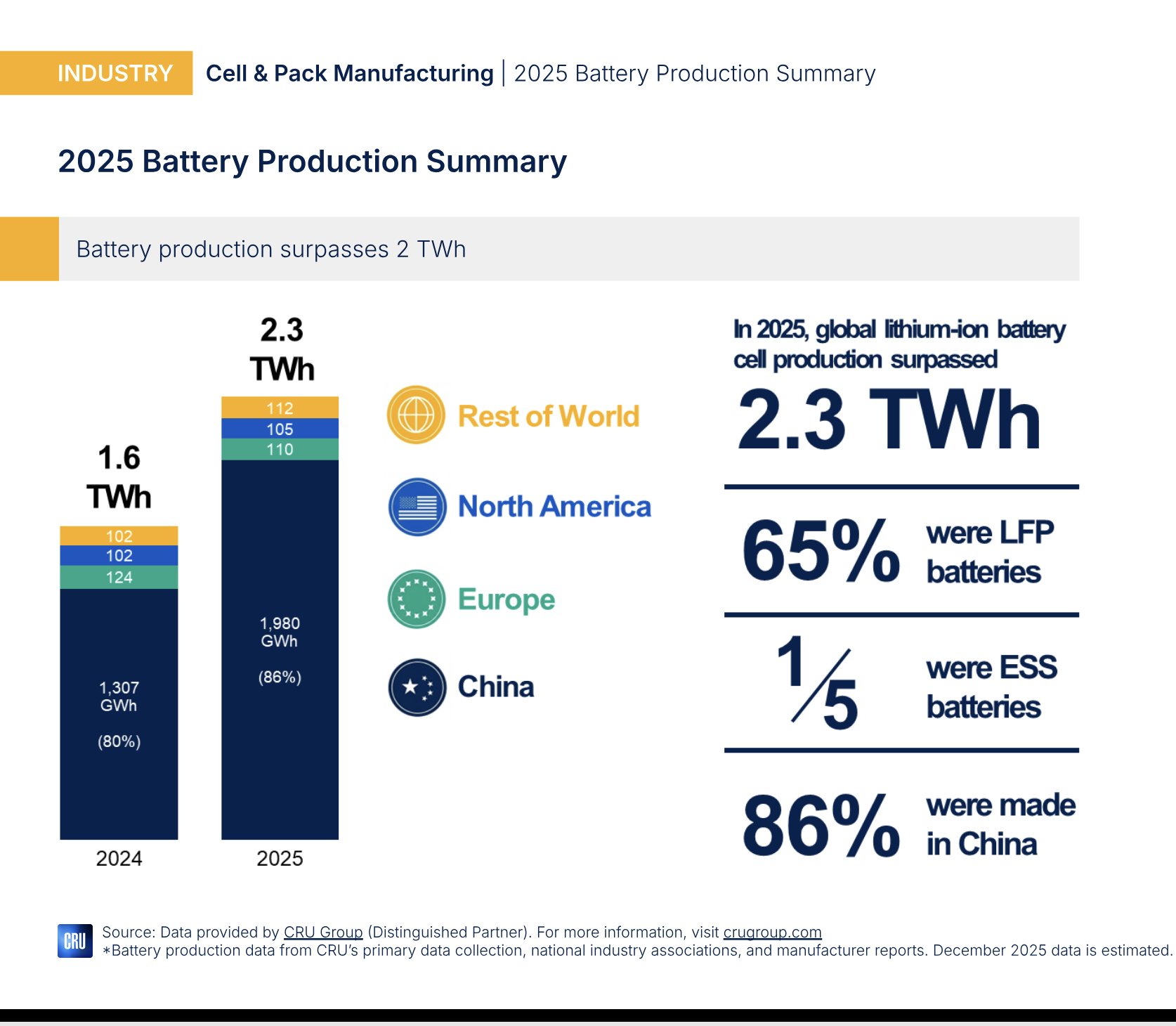
China rollouts: China is closest in aggregate capacity. Chinese battery manufacturers have annual production capacity exceeding 3 TWh -- roughly equivalent to 6-hours of total US electricity consumption. Total lithium-ion production reached about 2.3 TWh globally in 2025, with around 2 TWh located in China.
And that is going to increase fast. Scheduled Chinese capacity plus expansions amount to 6.4 TWh across 193 plants — equivalent to about 5.6-hours of Chinese electricity consumption. If even half were deployed in battery energy storage systems, analysts say it could accelerate solar and wind overbuild and displace coal generation more rapidly than grid operators can adjust.
China’s battery roll out is massive as it tries to consolidate its lead as the world’s most prolific power producer. As bne IntelliNews reported, electric power is increasingly becoming geopolitical power as the world’s economies shift from being carbon-dependent to silicon based driven by data and electrons. The power capacity of Chinese utility-scale batteries increased by more than 12 times between 2020 and 2024, according to the Paris-headquartered International Energy Agency (IEA) Electricity 2026 report.
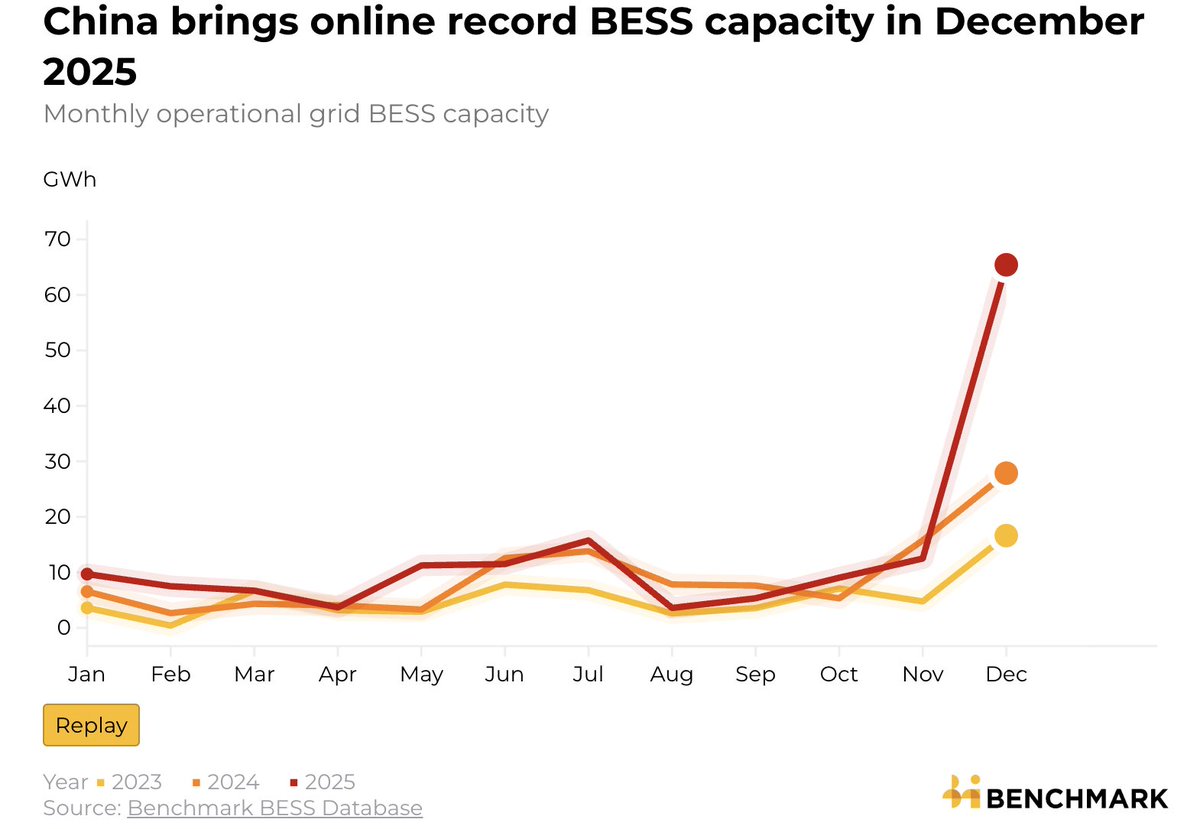
Thanks to Chinese investment and mushrooming production, the global average cost of batteries has more than halved (58%) from $511.2/kWh in 2019, to just below $213/kWh in 2024. However, there is still a long way to run to reach the crucial 8-hour battery arrays.
The IEA says batteries with higher storage durations are seeing the most rapid cost declines and increasing the average duration from 1.5-hours in 2024, to 2.5-hours in 2027.
“In China, the average duration of cumulative new-type energy storage installations increased from about 2.1 hours in 2021, to around 2.6 hours in 2025,” the report says.
“California stands out for its concentration of battery storage with a 4-hour duration, in part due to Resource Adequacy rules, that assign capacity value based on sustained output over this period.”
“Markets such as California, Germany, South Australia (SA), Texas and the United Kingdom have all seen robust deployment of utility scale battery storage in recent years. In these places, batteries are increasingly available to meet demand when it peaks.”
US rollouts: The US is moving towards rolling out eight-hour batteries, especially in places like Texas and California, the US’ leading regions for green energy. In 2017, only 500 megawatts of grid battery capacity were online in the US; now, there are individual battery installations larger than 500MW. More than 13GW of energy storage was installed across the US last year, according to a new report from the Business Council for Sustainable Energy and BloombergNEF. That’s up from the roughly 12GW installed in 2024.
California has one of the world’s largest installed fleets of grid-scale batteries, but it has not yet reached the eight-hour storage threshold at a system-wide level. To date, most utility-scale batteries have been plugged into the grids of Texas and California, two solar-soaked states with radically different approaches to encouraging storage growth.
According to data from the California Independent System Operator (CAISO) and the US Energy Information Administration, the state had more than 10 GW of battery storage capacity installed by late 2025, most of it added over the past four years. That makes California the largest battery market in the US and one of the largest globally.
In energy terms, California’s 10-GW fleet typically equates to roughly 40 GWh of storage. On peak summer days, CAISO demand can exceed 45GW. Eight hours of storage at that level would require about 360 GWh — nearly nine times current installed battery capacity.
California’s batteries have nevertheless reshaped grid operations. During spring afternoons, when solar output is high and demand relatively low, wholesale prices frequently fall close to zero or turn negative. CAISO data also shows that batteries now routinely supply more than 20% of evening peak demand for short periods.
Australia rollouts: Australia has emerged as another green energy leader thanks to its copious amounts of sunshine and the population’s embrace of roof-top panels.
It has expanded battery deployment sharply, led by projects such as the Victorian Big Battery and the Hornsdale Power Reserve in South Australia. However, most large-scale batteries connected to the National Electricity Market where 95% of capacity post-2024 is designed for 2-hours and 4-hours are accelerating rapidly. While longer-duration projects are planned, Australia has not yet reached eight hours of storage sufficient to cover national baseload demand.
Follow us online