
Emerging Asia's LNG power play was failing long before the Iran war - IEEFA

Emerging Asia's plan to run its power grids on imported gas was unravelling years before the Iran war shut the Strait of Hormuz, according to the Institute for Energy Economics and Financial Analysis (IEEFA).
The US-based think tank tracked 92 proposed LNG-fired power plants and 44 import terminals in Vietnam, the Philippines, Thailand and Bangladesh in a report released on November 5. Plants worth $56.1bn and terminals worth $11.7bn were cancelled, withdrawn or left idle between 2021 and 2026, amounting to $67.8bn, nearly 4.5 times the value of projects completed.
The four countries sit at the centre of the gas industry's forecasts for the next wave of LNG demand, and traders have signed up supply on the assumption that they will take it. If the plants are not built, those cargoes need other homes. The Iran war has since added a further test of the region’s reliance on imported gas.
"The region's LNG expansion has progressed far more slowly than the global gas industry expected," said Sam Reynolds, who leads IEEFA's gas and LNG research in Asia and co-wrote the report with Christopher Doleman.
Slow to build, quick to die
Just 11% of the proposed generating capacity and 15% of the terminal capacity came online over the five years. The plants that were finished took more than seven years on average from first public announcement to commissioning, roughly twice the three to four years developers tend to promise. What survives is a pipeline of 33 power plants worth $42.5bn and 17 terminals worth $6.2bn, still in development.
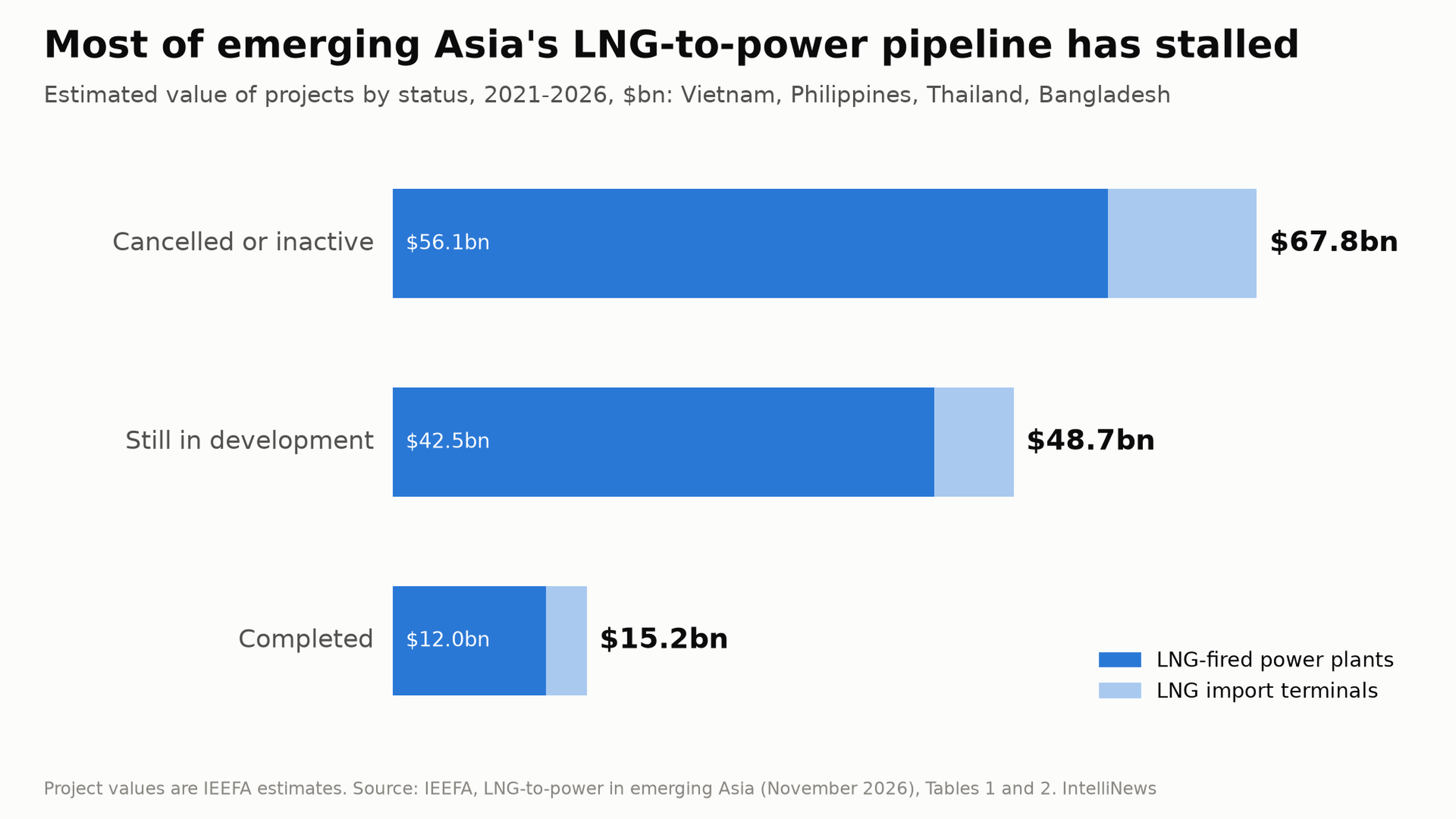
Estimated value of LNG-fired power plants and import terminals in Vietnam, the Philippines, Thailand and Bangladesh by status, 2021-2026. Source: IEEFA. IntelliNews
Vietnam accounts for the biggest losses. At least 20 projects with nearly 33GW of capacity have been cancelled or dropped from government priorities, and the developer of the 4.8GW Hai Phong plant, the largest LNG-fired project in the national power plan, proposed withdrawing it in March after the Middle East conflict broke out. Vingroup, its developer, found the plant's need for 5mn tonnes of LNG a year untenable on cost and currency risk, according to the report. Only one LNG-fired project in the country, the 1.6GW Nhon Trach 3 and 4 complex, has reached commercial operation.
The Philippines has completed one plant, a 1,750MW facility whose first units came online in May 2025, while 13 others worth over $14bn are assumed dead. None of the 6.5GW of LNG-fired capacity still planned there has secured gas turbines, and IEEFA does not expect a new gas plant to run before 2031.
Thailand commissioned four projects worth $7.2bn, but 10GW of capacity worth an estimated $7.9bn was cancelled or went quiet.
In Bangladesh, 10 LNG-to-power projects worth nearly $7.7bn have been cancelled, withdrawn or stalled, and the interim government tore up contracts with Summit Group and Excelerate Energy for two floating terminals in 2024. State gas company Petrobangla's supply costs were still more than 50% above what it charged large power generators in 2025, even after a 248% rise in their tariffs over five years.
The arithmetic turns against gas
Spot LNG in Asia averaged $6.56 per million British thermal units (MMBtu) between 2016 and 2020. With about a fifth of world supply shut in since February, the price more than doubled to $27.5/MMBtu by September 18. At that level one cargo costs about $100mn, and a 1GW plant running at baseload burns some 14 cargoes, or $1.35bn of fuel a year.
Equipment has followed the same path. A global rush for gas turbines, driven largely by US data centres, has pushed construction costs for new US gas plants to $2,500-3,000 per kW, against as little as $785 per kW four years ago. The currencies of Bangladesh, India, Thailand, Vietnam and the Philippines have lost an average of 25.6% against the dollar since 2021, raising the local cost of fuel and debt paid in dollars.
In IEEFA's model of a 1GW plant in Vietnam, dearer fuel lifts the levelised cost of power from $88 per MWh to $153, and current turbine prices take it to $176. Add the dong's 15% slide and the cost in local currency comes to 2.3 times the 2021 baseline. New solar in Vietnam cost $44 per MWh and wind $78 this year, on BloombergNEF figures the report cites.
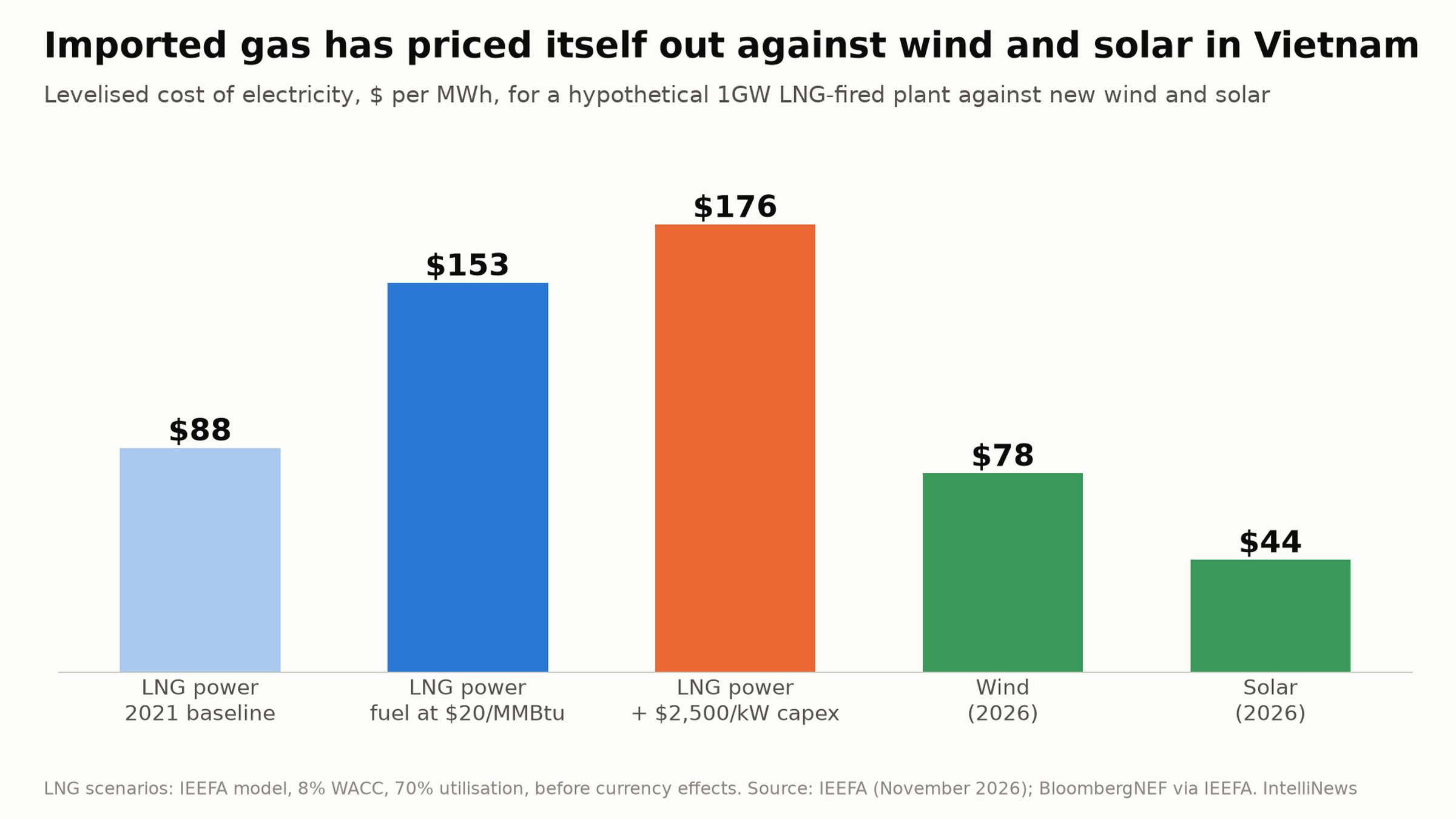
Levelised cost of a hypothetical 1GW LNG-fired plant in Vietnam under rising fuel and equipment costs, against new wind and solar. Source: IEEFA; BloombergNEF. IntelliNews
Politics enters the supply chain
Supply has proved as unreliable as cost. QatarEnergy has extended force majeure on deliveries to Bangladesh and Pakistan until the end of December, having shipped Bangladesh less than a quarter of its contracted cargoes this year.
Taiwan said on November 6 that it would close its representative office in Papua New Guinea, withdraw its staff and sign no new spot contracts for the country's LNG, having stopped spot buying after Port Moresby ordered the office shut in July, Focus Taiwan reported. The foreign ministry blamed Chinese political and economic pressure, and said Taiwanese purchases made up about a third of Papua New Guinea's exports.
The rupture costs Taipei little. Papua New Guinea supplied 8% of Taiwan's gas imports in 2025, against 34% from Qatar and 33% from Australia, AFP reported, and the island is looking to restart two nuclear plants with 3.84GW of capacity pending a mid-November election. The loss falls on a seller whose ExxonMobil-led plant ships 8.3mn tonnes a year to China, Japan and Taiwan. A rich buyer can walk away from a supplier; a poor one like Bangladesh, stuck with Qatari contracts that do not deliver, cannot.
Gas still has a role in the region, however, but a smaller one than its sellers planned for. Wood Mackenzie expects only 14.9GW of the 53GW of gas-fired capacity planned across six Southeast Asian markets to be running by 2030. "As these structural constraints persist, expectations of rapid, large-scale LNG demand growth in emerging Asian markets warrant closer scrutiny," IEEFA concluded.
Follow us online