
EU gas stocks sink below 2021 lows before the hardest winter in five years

Europe's gas tanks are emptier than at any point on record for the time of year, and the cargoes that should be filling them are sailing to Asia instead.
EU storage sites hit a record low in percentage terms on August 1, at 57.2% full against 57.3% on the same date in 2021, the previous worst year. Because storage capacity has grown since, the absolute low came five days later: 659.5 TWh in the tanks on August 6, just under 2021's 659.9 TWh.
By August 10 sites were 59.1% full - 23.1 percentage points below the 2023-25 average of 82.2% for the date. The figures come from Argus, whose European natural gas market briefing of August 14 laid out the shortfall.
This is the position Europe will carry into the heating season, and it is arriving alongside a drought that is knocking out the hydro and nuclear generation that would otherwise spare the gas.
The cargoes that went east
The refill has stalled for one reason above all: not enough LNG is turning up. European imports over July 27 to August 9 were 15% below the same fortnight a year earlier, on Kpler data, even with winter closing in and every incentive to buy.
The gas has not vanished; it has gone somewhere warmer. Open inter-basin arbitrage has pulled uncommitted Atlantic-basin spot cargoes towards northeast Asia, where a hot summer and heavy cooling demand have held prices above what European buyers have been willing to pay.
Prices have swung accordingly. The TTF front-month contract peaked at €62.90/MWh on July 24, slid to €52.71/MWh on August 5, then climbed back above €60/MWh on August 10 and again on August 12. The August dip tracked hopes of a US-Iran deal; the recovery tracked those hopes fading.
That is the war doing the work. The Strait of Hormuz remains effectively closed, and with it a large slice of the Qatari LNG that used to reach Europe. Norwegian field outages have been extended on top.
Belgium runs dry
Nowhere shows the squeeze more sharply than Belgium, a transit hub whose terminal sendout sets flows across northwest Europe.
Sendout from the Zeebrugge LNG terminal fell to 22 GWh/d over August 3-9. The three-year average for that week is 188 GWh/d - Zeebrugge is running at roughly one eighth of normal.
Belgium had not taken a single LNG cargo since July 27, and only one vessel was scheduled for the rest of the month: the 174,000 cubic metre Venture Gator, out of the US Plaquemines terminal, due on August 27. Supply into one of the region's main entry points is set to stay tight until September.
That is a country whose entire July LNG intake came from Russia - and the EU as a whole took record volumes of Russian Arctic LNG from Yamal in the first four months of the year, even while Brussels was drafting the phase-out. The awkwardness of that arithmetic is about to get less theoretical.
The drought burns the rest
Wholesale electricity prices have hit their highest since 2023, and gas is what is filling the gap.
Cooling demand has surged through the heatwaves, while the water used to cool nuclear reactors has dwindled and hydro output has fallen with the rivers. Renewables have absorbed some of it; gas-fired generation has absorbed the rest, adding demand to a market that was already short. The Danube hit a record low of 31 centimetres this month, idling reactors across central Europe.
The damage runs beyond the power sector. Oxford Economics reckons the droughts will shave 0.2 percentage points off eurozone GDP in the third quarter, effectively flattening the economy. The largest single hit comes from extremely low water on the Rhine, the artery connecting German industry to the Dutch ports. Wildfires in Spain and France will dampen activity, though the rebuilding afterwards will add spending back, and a poor harvest will push food prices up later, squeezing incomes.
The wider economy has held up better than expected so far. The Sentix investor survey climbed back to its long-run average in August, driven - surprisingly - by the assessment of current conditions rather than expectations, which are back to where they sat before the US-Iran war. Eurozone industrial production was flat in June, a small German rise offset by falls in France and Italy; excluding Ireland, output fell 0.2% m/m.
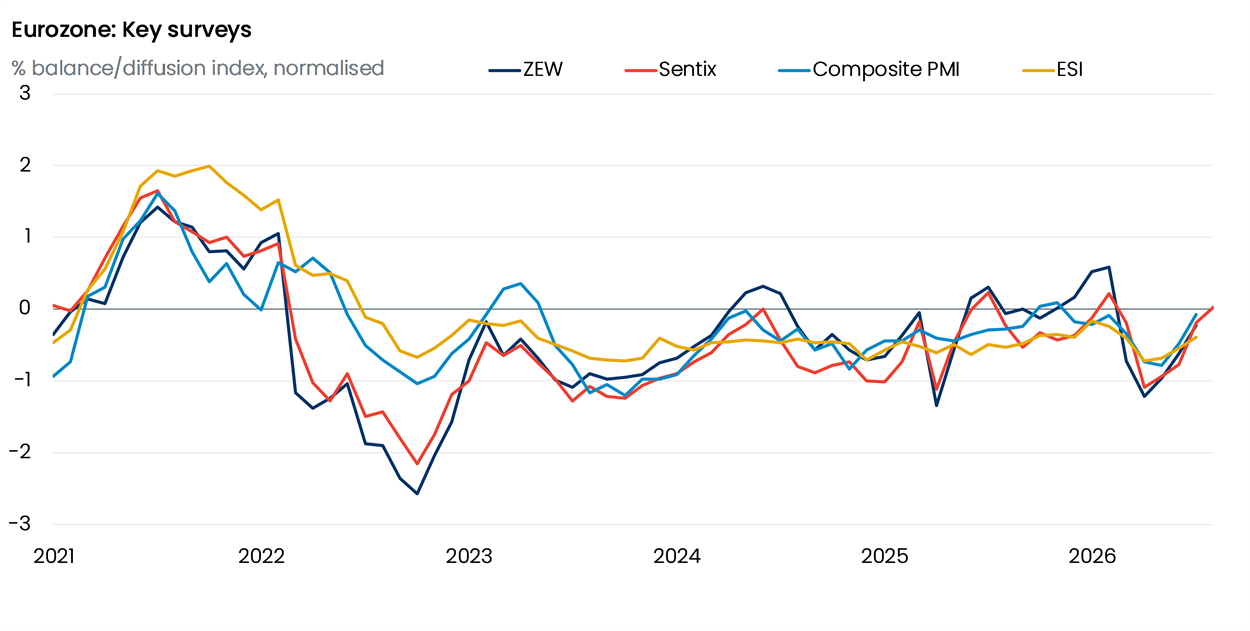
Eurozone key surveys, normalised balances. Source: Oxford Economics, Haver Analytics, S&P Global.
Oxford Economics is not reading much into the improvement. Surveys typically drop hard after a shock and recover gradually regardless of what follows, and the research house expects resilience to prove short-lived as weather shocks bite, temporary supports unwind and the winter arrives.
Not 2022, but not comfortable
The obvious comparison is the 2021-22 energy crisis, and it is the one Oxford Economics is most careful about.
The differences are real. There is no structural disruption to supply this time. LNG availability and import capacity have both grown. Demand is lower than it was. Utilities are better hedged. Europe can genuinely run on lower storage than it used to need.
What it has to do instead is outbid Asia for every flexible cargo, which is precisely what it has been failing to do since late July. There is at least a ceiling on that contest: Asian buyers took their own lesson from 2022 and diversified away from gas, often back to coal, which caps how far they will chase a price spiral.
Two risks sit on top. The first is the weather - a sustained cold spell would send prices sharply higher from a low base. The second is Moscow. Russia still supplies almost 15% of the EU's gas imports, and could throttle them abruptly as part of a winter offensive. Oxford Economics calls that the key tail risk.
The price forecasts are already moving. The research house will revise its gas price projections up in September, which on its own arithmetic keeps inflation above 3% into 2027 and keeps the European Central Bank hawkish. Its confidence in a rate rise to 2.5% in September has gone up.
A problem that has been building since spring
None of this arrived without warning. IntelliNews flagged in the spring that the EU would struggle to refill its tanks over the summer after an unusually cold winter left storage near 20%, and that a normal refill pace would leave the bloc around 70-75% full at the start of the heating season rather than the mandated 90%.
The outturn has been worse than that. The shortfall is also very unevenly distributed, concentrated in Germany and the Netherlands, which hold the largest working volumes and therefore the largest absolute gaps - a distinction the headline percentage hides.
Belgium's empty terminal is the same story told through one pipe. A hub with no cargoes booked for three weeks, in the middle of the refill season, in the year Europe has least room to spare.
Follow us online