

Falling battery prices make round-the-clock solar power supply viable in India
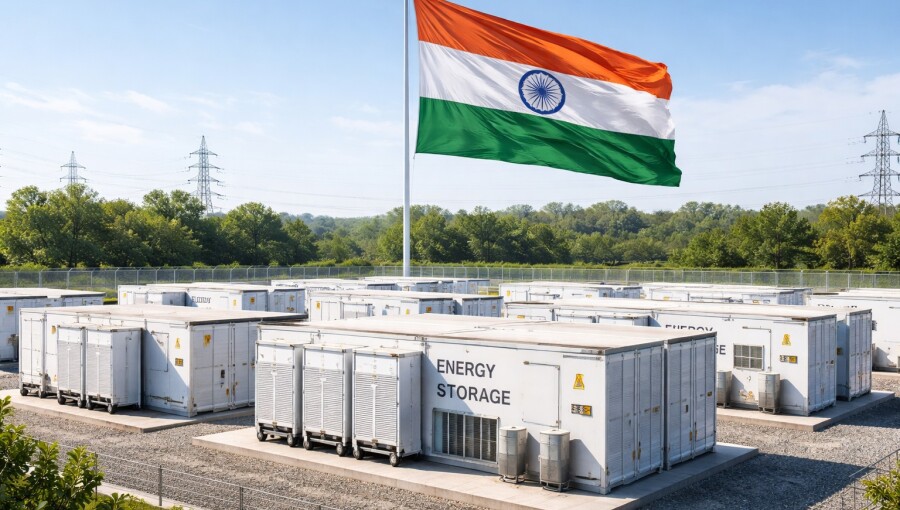
A recent report by energy think tank Ember says that declining battery storage costs have reached a level where it makes it economically viable for solar power to store and supply most of India’s electricity demand. The report says that solar combined with batteries may meet up to 90% of the country’s electricity requirement at competitive costs.
The report, which was published on April 7, says that a major reduction in battery prices over the last two years has significantly changed the dynamics of India’s renewable energy space. The estimated cost of battery storage saw a reduction of almost 40% in 2024 and nearly 31% in 2025. This makes round-the-clock solar power extremely attractive.
The report argues that if solar generation is combined with battery storage, nearly 90% of India’s electricity demand can be fulfilled at a levelised cost of electricity (LCOE) of about INR5.06 ($0.055) per kilowatt-hour. This is similar to, or cheaper than, the average power procurement costs in many Indian states.
In order to get to that level of supply, India would require almost 930 gigawatts (GW) of solar capacity and 2,560 gigawatt-hours (GWh) of battery storage. This is equivalent to nearly 4.9 GW of solar and 13.5 GWh of storage capacity per 1 GW of average demand. Even if India achieves this scale, only about 5% of solar generation every year would need to be curtailed due to excess supply.
Ember report says that India’s solar potential is vast and mostly untapped. The country boasts of about 143 GW of installed solar capacity, which represents just a fraction of its estimated 3,343 GW ground-mounted solar potential. This potential alone could generate approximately three times India’s current electricity demand.
To unlock this potential, battery storage will play a significant part because of its intermittency. While solar power output peaks during the day, batteries assist in storing the excess energy, which can be utilised during the evening and night. Ember report highlights that during months with strong sunlight, such as January to April, solar and batteries could meet nearly 100% of daily electricity demand.
However, the main challenge is the monsoon season. During the cloudy months, there would be long periods of low solar output, which would limit the ability of batteries to maintain supply over several consecutive days. In July, which is the peak monsoon month in India, solar and battery systems could meet around 66% of demand due to reduced solar generation. This highlights the need for a diversified energy mix, including wind and hydro, to complement solar during such periods.
At the state level, findings presented by Ember are equally important. The analysis of the ten largest electricity-consuming states shows that solar-plus-battery systems could meet between 83% and 92% of their annual electricity demand. Seven of these states could achieve 90% or more, with Andhra Pradesh leading at 92%, while Uttar Pradesh records the lowest share at 83%.
The report also says that the cost of power generated through solar and batteries is already lower than current procurement costs in several states. In six major states, solar-plus-storage systems are already delivering around 90% of electricity demand, which could be 15% lower than current power purchase costs. The southern state of Karnataka could achieve a cost reduction of 21%, while the western state of Gujarat could see savings of around 7%.
Even if the transmission costs for sourcing solar power from resource-rich regions are taken into consideration, the overall economics remain attractive. Additional costs of around INR1.2 to 1.5 per unit for transmission and losses do not in any major way reduce the competitiveness of solar-plus-battery systems, especially when there exist policy support schemes such as waivers on interstate transmission charges.
The report further highlights the reduction in costs of solar and battery storage, with the increasing costs of power produced through coal. Recent coal power tariffs in India have ranged between INR5 and INR6.3 per unit, driven by higher capital costs, stricter environmental regulations, declining coal quality and operational inefficiencies. In comparison, solar-plus-storage tariffs are typically fixed over the contract period, offering greater price stability and insulation from fuel price volatility.
The recent auctions of solar-plus-storage projects in India have discovered rates that are as low as INR2.9 to INR3.5 per unit for systems with four-hour battery storage. When it comes to a six-hour battery storage project auction, early 2026 saw a tariff of INR3.12 per unit, pointing to a further drop in the future, Ember noted.
The Ember report expects the economics of solar and battery storage to become even more attractive, which may lead to wider deployment. While achieving 100% solar-based electricity would require significantly higher investment, reaching 90% is both technically feasible and economically viable.
According to Ember, the most significant question is no longer whether solar can lead India’s power system, but how fast the system can be scaled up. With significant solar resources, reducing technology costs and supportive policy frameworks, India can easily become a global leader in clean energy, Ember added. This will also reduce the country’s dependence on imported fossil fuels.
Follow us online