


Heating season starts as the first EU gas tanks flip to drawdown - IntelliNews Lambda

Half of the EU's gas-storage countries were drawing down their tanks on November 1, the first day of the heating season, as Europe began burning a record-low winter reserve.
EU storage was 74.56% full on the day, holding 844 TWh against 1,132 TWh of working capacity, after a net outflow of 980 GWh, according to Gas Infrastructure Europe's AGSI platform [1]. It was the fifth straight day of net withdrawals since storage peaked at 74.96% on October 27, the lowest seasonal peak since records began in 2011.
Nine of the 18 EU countries that report to GIE took more gas out than they put in. France drew a net 339 GWh, Italy 277 GWh, the Netherlands 180 GWh and Austria 140 GWh, while Czechia, Slovakia, Bulgaria, Croatia and Hungary also turned negative [1]. Poland, which is 99.3% full, Denmark, Romania and Belgium were still injecting.
Most of the map is still green, but it will turn red as the cold sets in, and Europe is starting the winter about 165 TWh, or 14.6 percentage points, below the IntelliNews Lambda 15-year seasonal baseline of 89.1% for November 1. How fast the countries flip from filling to burning will set the price of gas for the rest of the winter, and it will show first in the countries already short: Germany, the Netherlands, Austria, Slovakia and Latvia, all between about half and two-thirds full.
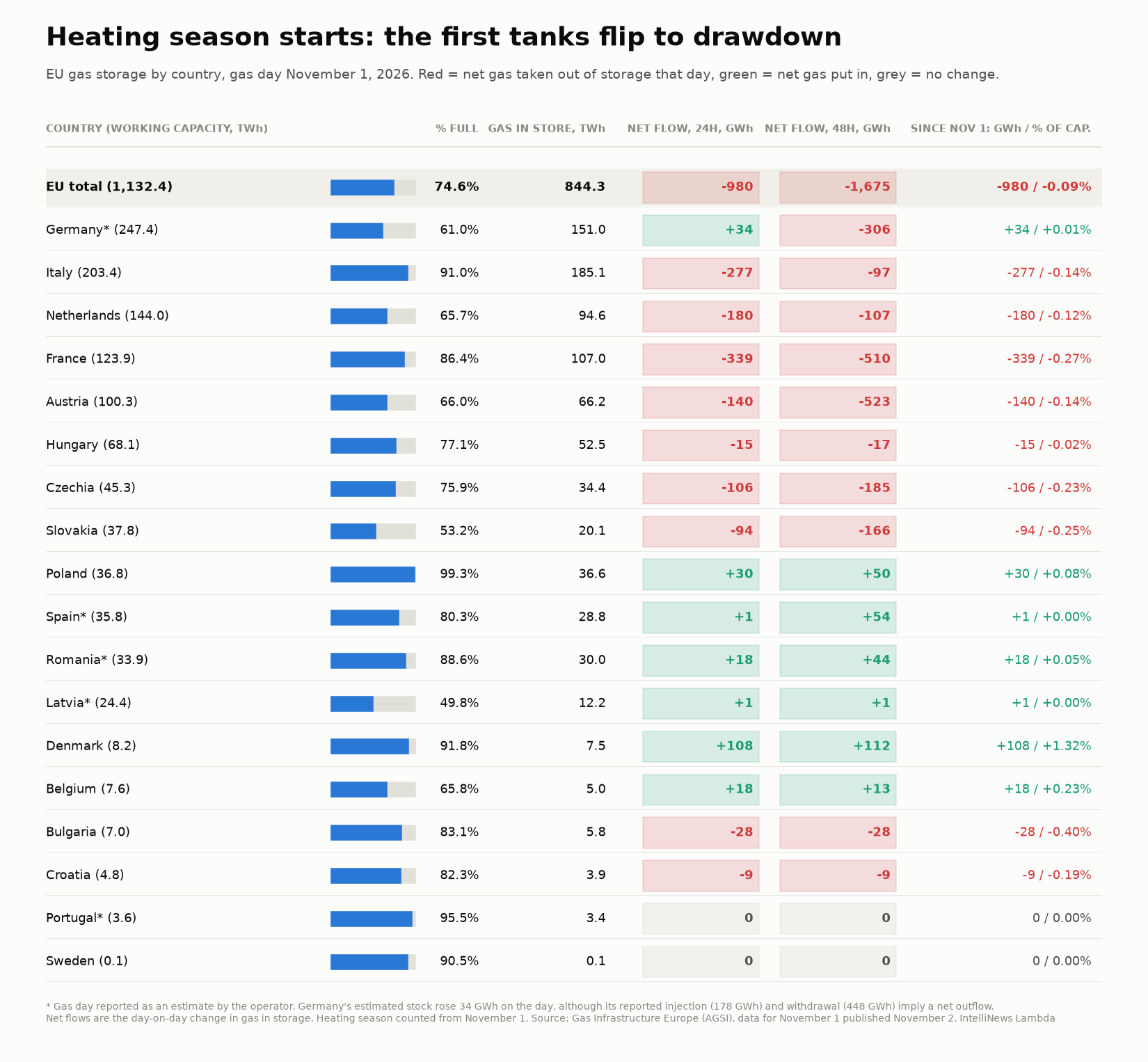
EU gas storage by country, gas day November 1, 2026: % full, gas in store and net flows over 24 and 48 hours and since November 1. Red marks a net withdrawal. Source: Gas Infrastructure Europe (AGSI). IntelliNews Lambda
Germany is the outlier in the data. Its stock rose by an estimated 34 GWh on November 1, but the operators reported 448 GWh of withdrawals against 178 GWh of injections, which implies a net outflow, and the German figure is flagged as an estimate [1]. Germany has the largest storage in the EU, at 247 TWh, and it was only 61.05% full.
The storage forecast held
IntelliNews Lambda forecast in August that EU storage would be 77% full on November 1, with a one-in-two chance of landing between 72% and 80%. The tanks came in at 74.6%, 2.4 percentage points under the central case and inside that band.
Germany came in lower. The model put German storage at 67.3% on November 1, with an 80% band of 55% to 75%, and Germany started the heating season at 61%, inside the band but six points under the central case, and well short of its 80% legal target. Germany accounted for about two-fifths of the EU's missing gas in August and it has not closed the gap since.
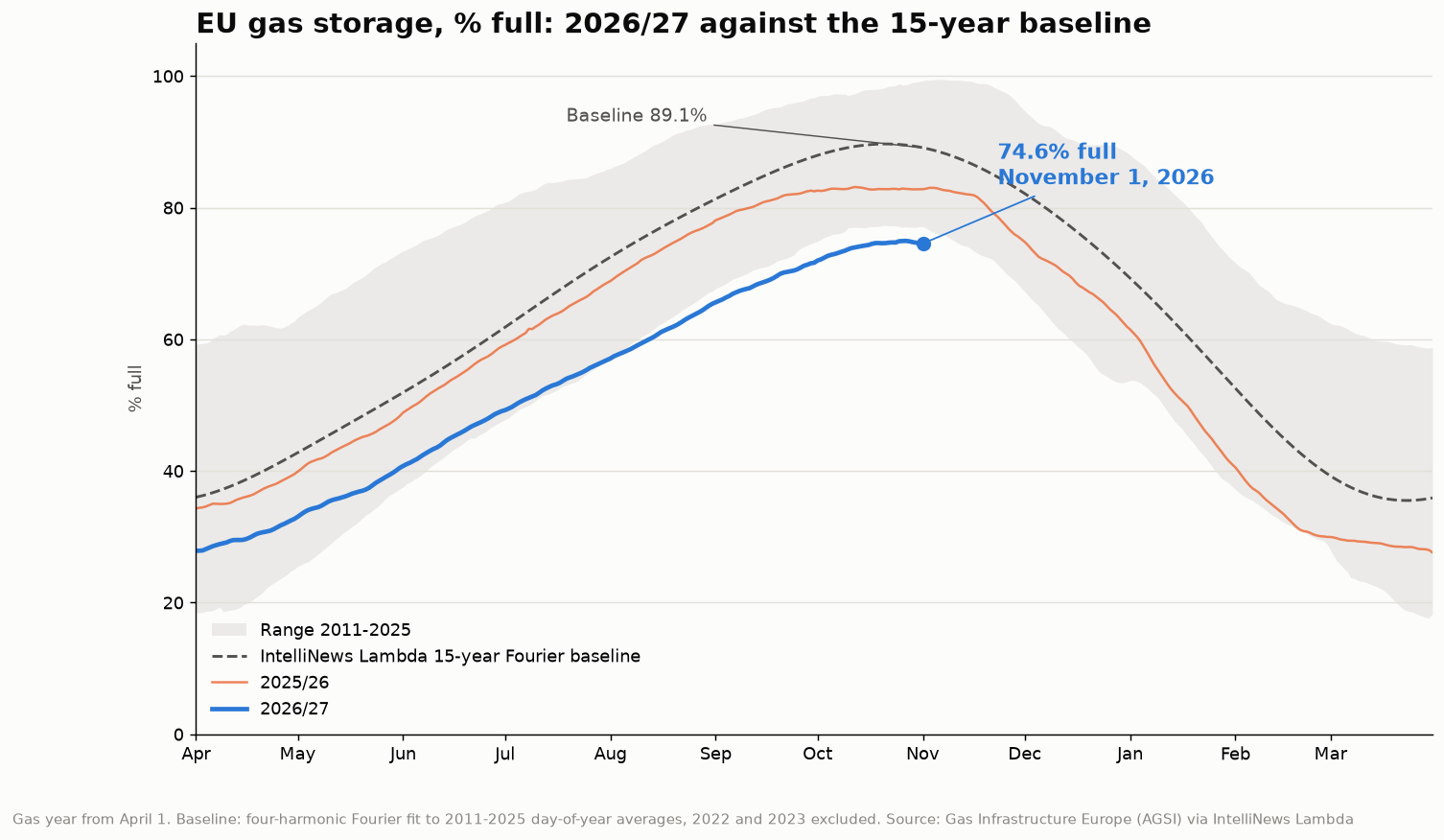
EU gas storage, % full, gas year 2026/27 against 2025/26, the 2011-2025 range and the IntelliNews Lambda 15-year Fourier baseline, to November 1, 2026. Source: Gas Infrastructure Europe (AGSI) via IntelliNews Lambda
Price ran ahead of the model
The price has done worse than the storage forecast suggested. In August the model gave a median January price on the Dutch TTF hub of €67 per MWh, with an 80% band of €49 to €97 and a 9% chance of topping €100. The benchmark broke through €100 per MWh on October 28, for the first time since December 2022, two months before January.
It eased to about €95.21 per MWh on November 2 after Iranian President Masoud Pezeshkian said Supreme Leader Mojtaba Khamenei had authorised talks with the US, TASS reported. The October average was about $1,000 per 1,000 cubic metres, or roughly €85 per MWh, 2.6 times the level of a year earlier, the agency calculated from ICE data.
Fundamentals do not explain the whole move. Across 189 months from 2011 to September 2026, the storage gap to the baseline, Brent and coal together explain 84% of the variation in the European gas price [2], and each percentage point of missing storage adds about 1.4% to the price. On that basis October's price should have been about €66 per MWh. The market paid about 29% more, against a premium of 19% in August.
That premium is the Gulf. LNG tanker traffic through the Strait of Hormuz in September and October was only about a quarter of pre-war levels, TotalEnergies CEO Patrick Pouyanné said on October 29, and Europe and Asia are bidding for the cargoes that remain. Goldman Sachs has forecast €150 per MWh if a cold winter coincides with a continued blockade of the strait, IntelliNews reported, and the UN refugee agency UNHCR has warned of a hard winter as Ukraine's heating season begins under Russian strikes on its energy system.
Where the winter ends
IntelliNews Lambda has rerun the projection on the November 1 data. It carries this year's gap to the baseline through the weather of each of the 15 winters since 2011/12, so every past winter becomes a scenario for this one.
The EU's median outcome is a low of about 23% full in early April, against a baseline of 36% for the end of March, little changed from the 24.4% projected in August. The 10th-to-90th percentile range runs from 8% to 34%. Only the mildest winters on record leave Europe near its normal end-of-season level.
Germany's outlook has worsened. Its median low is now about 13%, down from 24% in the August run, because it started the winter six points lower than projected. In six of the 15 analogue winters German storage falls to the technical floor of about 5% that the model allows, and in practice that would mean prices rising far enough to cut demand before the caverns ran dry. The rationing would happen in the price.
Anchored on October's premium, with Brent and coal held at September levels, the model puts this winter's peak monthly average price at a median of €90 per MWh, with a 10th-to-90th percentile range of €82 to €99. The worst case, a repeat of the 2017/18 winter and its late cold snap, reaches €103. Run on the German storage gap, the median peak is €88. These are monthly averages, so daily prices will spike higher, and Goldman's €150 lies beyond every one of the 15 winters: it needs a supply shock on top of the cold, which is the risk the Gulf still poses.
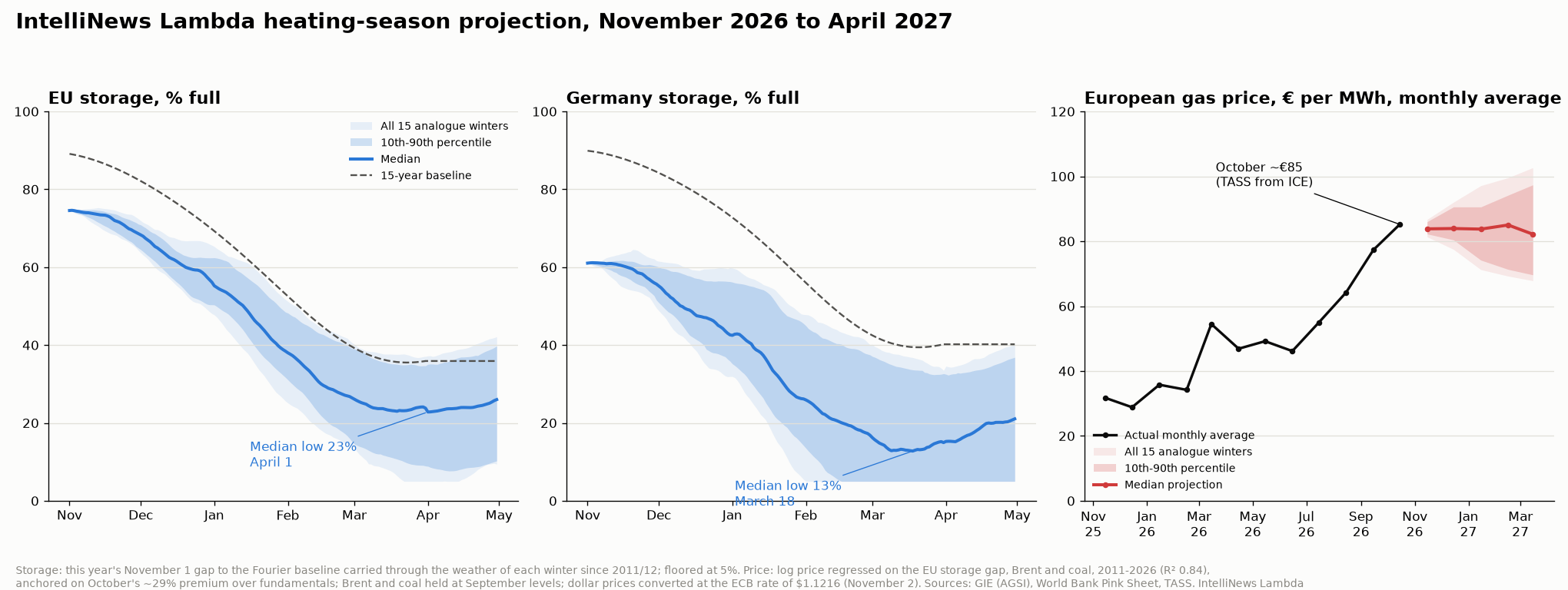
IntelliNews Lambda heating-season projection, November 2026 to April 2027: EU and German storage, % full, and the European gas price, € per MWh, monthly average. Sources: Gas Infrastructure Europe (AGSI), World Bank Pink Sheet, TASS. IntelliNews Lambda
Less Russian gas next year
The supply side will tighten again in January. The EU's ban on Russian LNG under long-term contracts starts on January 1 and piped imports are to be phased out completely by the fourth quarter of 2027, which will cut Russian gas exports to the EU by 30bn cubic metres in 2027 compared with 2026, the International Energy Agency said in its quarterly Gas Market Report on November 3, TASS reported.
Russian LNG deliveries to the EU fell by 30%, or 1bn cubic metres, in the third quarter, while pipeline deliveries rose 1.5% in the first nine months and still covered about 8% of European demand, the IEA said. Gazprom's contracts with Turkey expire at the end of 2026, and not renewing them "could reduce Russia's piped gas deliveries to Turkey by more than 6 bcm y-o-y in Q1 2027, further tightening the regional and global gas balance," the agency said.
Russia shipped a record 3.42mn tonnes of LNG in October, and the EU took 12.87mn tonnes in January-October, up 6.5% y/y, or 45% of all Russian shipments, Kommersant reported. Those cargoes have to find new buyers from January, just as Europe's tanks reach the steepest part of the winter drawdown.
Sources:
[1] Gas Infrastructure Europe, AGSI aggregated gas storage inventory, daily country and EU data, gas days October 30 to November 1, 2026, published November 2, 2026
[2] World Bank, Commodity Price Data (Pink Sheet), Natural gas, Europe; Crude oil, Brent; Coal, Australian, monthly, January 2011 to September 2026, published October 2, 2026
This article was produced with the help of the IntelliNews Lambda analytical tool
Follow us online