
India, Pakistan lead emerging Asia's clean-power surge as carbon markets form

Emerging Asia is adding wind and solar faster than ever as the Hormuz energy shock pushes fuel importers to make their own power, with Pakistan and India out in front.
Developing economies outside China will add as much renewable capacity as advanced economies over 2026-2031 for the first time, the International Energy Agency (IEA) forecast in Renewables 2026, published on November 6. Asia Pacific excluding China accounts for more than 840 GW of new capacity, over twice what it built in 2020-2025. India supplies nearly half of the regional growth and the Association of Southeast Asian Nations (ASEAN) a fifth, and solar makes up almost 80% of it.
The centre of gravity is shifting. China's share of global additions falls from 61% in 2025 to about 53% over the forecast period as Beijing's switch to auctions cools the country that became the world's green energy champion. Its neighbours are buying security more than climate credentials. Disrupted flows through Hormuz, one of the world's key chokepoints, have turned imported fuel into the risky option, and more than half of the gas-fired power plants planned in Vietnam, the Philippines, Thailand and Bangladesh had already stalled or died before the war. Carbon finance is now starting to follow the panels.
Pakistan sets the pace
Measured by the change in wind and solar's share of electricity generation between 2024 and 2025, Pakistan improved most among the eight emerging Asian economies that energy think-tank Ember tracks monthly, adding 8.6 percentage points to reach 25%. India gained 3.7 points to 16.6% and Thailand 2.7 points to 7.2%. The momentum carried into 2026: wind and solar supplied 34.4% of Pakistan's power in 1Q26, up from 27.6% a year earlier, and 17.6% of India's.
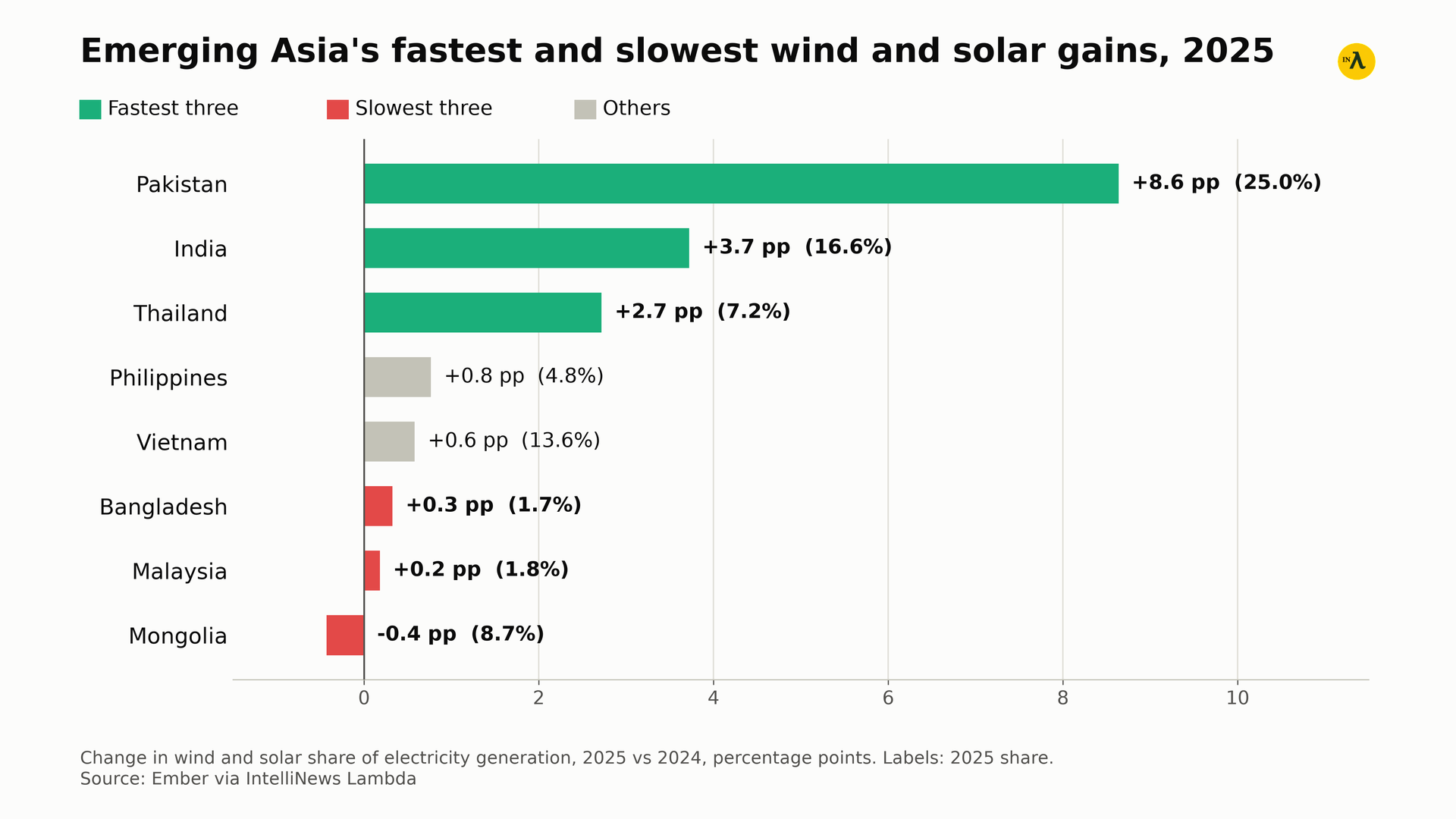
Change in wind and solar share of electricity generation, 2025 vs 2024, percentage points, for the eight emerging Asian economies in Ember's monthly data; labels give the 2025 share. Source: Ember via IntelliNews Lambda
At the other end, Mongolia's share slipped 0.4 points to 8.7%, while Malaysia and Bangladesh each gained less than a third of a point, leaving wind and solar below 2% of their generation. Malaysia still takes 22% of its power from renewables, but almost none of it from wind and solar.
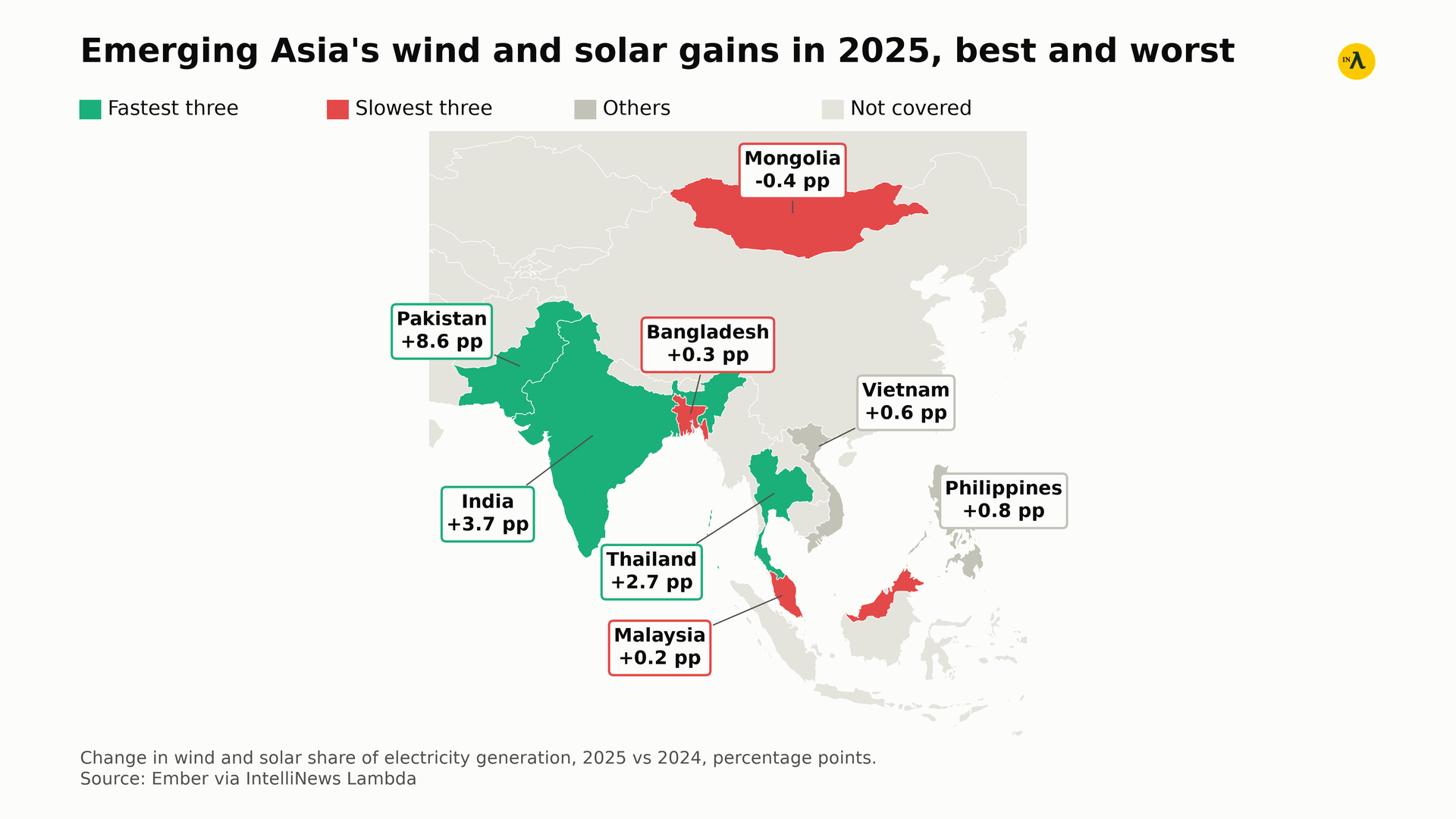
The three emerging Asian economies that raised the wind and solar share of their electricity generation most in 2025 against 2024 (green) and the three that raised it least (red), from Ember's monthly data. Source: Ember via IntelliNews Lambda
India's 900 GW question
New Delhi now talks of 900 GW of non-fossil capacity by 2035. Prime Minister Narendra Modi used the figure on September 30, when the cabinet approved the third phase of the Green Energy Corridor, an INR1.86 trillion ($19.8bn) programme to carry up to 135 GW of renewable power and add 50 GWh of batteries by 2032-33. That is almost double the 500 GW goal for 2030, against just over 300 GW installed today. India's formal Paris pledge is narrower, promising that non-fossil sources will make up 60% of installed capacity by 2035.
Wires are the constraint. India curtailed 14% of its solar output between April and June, and has approved a 1,150 kV corridor to move western solar power east.
"If the grid doesn't catch up, then there is no way India can meet this target," Nikit Abhyankar of the University of California, Berkeley's India Energy and Climate Centre told AP.
Carbon money follows
Singapore and Bangladesh signed a memorandum of understanding on Article 6 carbon credits on November 14 at the UN climate summit in Antalya, Turkey. The two will negotiate a legally binding implementation agreement setting rules for transferring credits.
"This collaboration represents a significant step towards unlocking new opportunities for carbon finance, fostering high-integrity carbon markets, and supporting the implementation of Bangladesh's NDC 3.0," said Shaikh Faridul Islam, Bangladesh's state minister for environment, forest and climate change.
Singapore is assembling a network of sellers. It signed its 13th implementation agreement, with Kenya, on November 16, and already holds such deals with Thailand, the Philippines, Vietnam and Laos. Companies liable for Singapore's carbon tax can use the credits to offset up to 5% of their taxable emissions.
A regional layer is forming alongside. The ASEAN Common Carbon Framework, launched at the 2024 UN climate summit in Baku by carbon market associations from Malaysia, Indonesia, Singapore and Thailand with the ASEAN Alliance on Carbon Markets, renewed its founding agreement for two years in Antalya on November 13, when the Philippines' Aboitiz Foundation joined as an observer. The body is industry-led, and its 2026-2028 strategy seeks official ASEAN standing.
The IEA reckons ASEAN's renewable growth could run 37% above its main forecast if governments finish the plumbing: direct power purchase agreements in Vietnam, third-party grid access in Thailand and new transmission finance in Indonesia. For Bangladesh, near the bottom of the table, a solar project that earns Article 6 credits would have a buyer in Singapore once the implementation agreement is signed.
Follow us online