


India’s renewable surge hits critical mass as solar drives structural shift
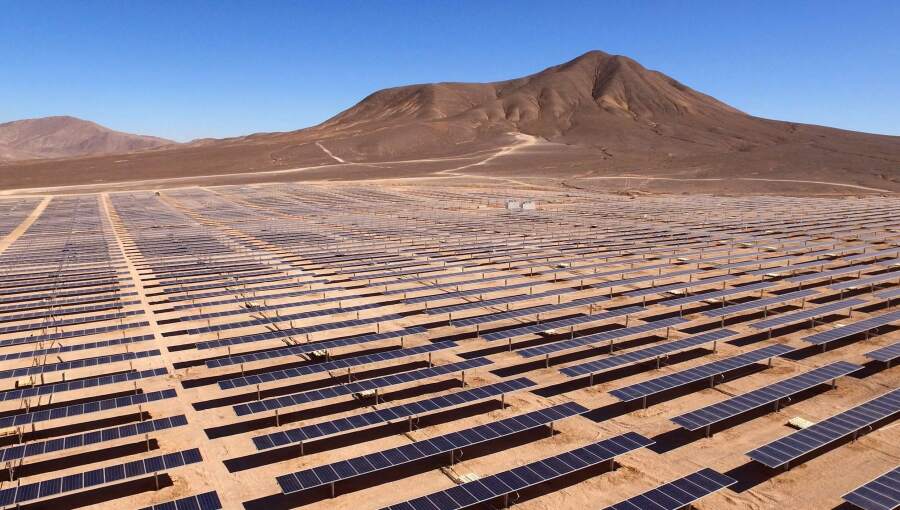
In part because of the ongoing limited flow of LNG and oil coming out of the Strait of Hormuz, but more as a result of solid policy implementation India’s renewable energy sector has entered a phase of striking acceleration.
Much of this has been underpinned by falling technology costs and a hard fought push for energy security in which the pace of expansion over the past 12–18 months has been particularly notable. As a result, record capacity additions have appeared as has a broadening of activity across the solar and wind sectors in particular and associated emerging segments such as storage. In turn this has led to a structural shift in how the country generates electricity.
The headline numbers are at times jaw dropping when compared to other countries. India added in excess of 55GW of non-fossil fuel capacity in the recently finished 2025–26 financial year alone. This is the largest annual increase on record for India, taking total non-fossil capacity to an estimated 283GW. This comes on top of 44.5GW added in 2025, with solar accounting for the overwhelming majority of new installations. As such, the scale of green energy deployment has pushed renewables to more than half of all installed electricity capacity.
What distinguishes the current expansion, however, is the speed at which renewable output is now outpacing demand growth across the subcontinent. In 2025 alone, renewable energy generation in India rose by roughly 98 terawatt hours, more than double the increase in electricity consumption. This subsequently led to a decline in coal-fired output, in the process marking a significant turning point given that for the first time ever in the country, clean energy is not simply supplementing fossil fuels but is beginning to displace them at scale.
Across India, solar power is the undisputed engine of this transformation. A record 38GW of solar capacity was installed in 2025, a 54% increase on the previous year. This was followed by an even larger 44.6GW of additional capacity in FY2026. At present, total installed solar capacity has now exceeded 150GW, making India the world’s third-largest solar market.
Several factors explain solar’s dominance in India. Utility-scale projects continue to benefit from some of the lowest tariffs globally—roughly $29–$31 per megawatt hour—The Times of India reports, while government-backed auction schemes have ensured a steady pipeline of projects.
At the same time, distributed solar is expanding rapidly nationwide. Rooftop installations added nearly 9GW in FY2026 alone and this has been supported by subsidy programmes aimed at millions of households and small businesses.
Crucially though, India’s solar expansion is increasingly tied to industrial policy as New Delhi has made wide-ranging efforts to reduce its dependence on Chinese imports across the PV supply chain.
Yet, while China still leads globally in polysilicon, wafers and modules production, India has introduced numerous production-linked incentives and tariff barriers to encourage domestic manufacturing and use.
This has in turn seen a gradual localisation of module assembly and, increasingly, upstream components brought to bear in a move as much about energy security as economics.
Wind power too, long overshadowed by solar, is also experiencing a much needed revival. India added just over 6GW of wind capacity in FY2026, which while significantly lower than the numbers seen in solar added, is its strongest performance in several years. As a result, wind output rose by around 28% in 2025. Policy reforms and implementation, particularly around hybrid auctions combining solar and wind at the same site, have seen a rise in investor confidence in a sector that had fallen behind in recent years.
Similarly, hydropower, though more mature in its exploitation, has also contributed to the recent surge thanks to favourable monsoon conditions which has seen generation rise by about 14% as recently as 2025. And while large hydro projects remain limited by environmental and social considerations, the sector can play a balancing role given the intermittent solar and wind output.
Beyond the typical core generation technologies, two adjacent sectors are gaining momentum and are increasingly coming to the fore in India. The first, battery storage, although constrained in its existence, has seen storage capacity expanding rapidly, supported in large part by falling costs and policy incentives aimed at stabilising the country’s grid. Globally, battery deployment rose sharply in 2025, and India was no different as renewables penetration increases and storage facilities are needed to avoid power loss.
The second is grid infrastructure and transmission – another sector affected by the rapid addition of renewable capacity as bottlenecks in India’s power network have been exposed. This has led to increased investment at the state and national level on transmission corridors and digital grid management.
Taken together, these developments suggest that India’s energy transition is entering a more mature phase.
Because of this, the country has moved beyond the headline-making capacity targets and is now facing a more complex challenge in which integrating large volumes of variable renewable energy into a still coal-heavy system must be seen to work given that coal remains dominant, accounting for around 70% of generation, but its share is beginning to edge downwards as renewables scale up.
To this end, the broader economic implications are significant in that renewable energy is no longer just an environmental policy tool but is a central pillar of industrial strategy, investment and job creation. With nearly 100GW of capacity added in just two years and hundreds more gigawatts in the pipeline, India is leading South Asia as both a major market and an emerging manufacturing hub for clean energy technologies.
Follow us online