
Philippine rooftop solar boom makes country China’s second-largest export market in 2026
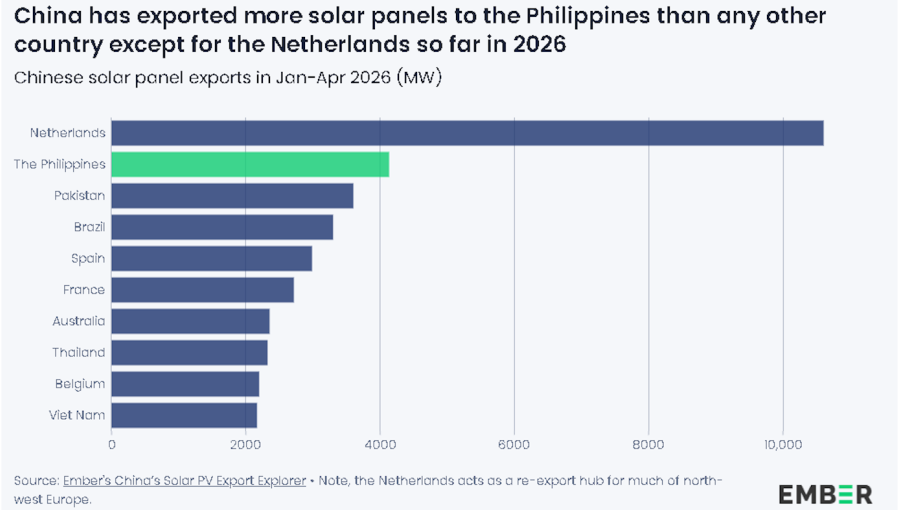
The Philippines has emerged as China’s second-largest export market for solar panels so far in 2026, driven by a rapid expansion of rooftop installations as households and businesses seek relief from some of the highest electricity prices in Southeast Asia.
It’s a bottom-up green energy revolution. The surge is being led largely by consumers rather than government mandates, highlighting how economics is increasingly driving the adoption of renewable energy in emerging markets. Millions of Filipinos are installing Chinese-made solar panels on homes and commercial buildings in response to the soaring price of power.
According to research by energy think-tank Ember, the economics of rooftop solar in the Philippines have become particularly compelling. The organisation said that “a Chinese solar panel — given cost of electricity in the Philippines — now has a payback period of only 3.1 years for households and 2.3 years for businesses”. The Chinese solar panels also have an expected working life of 30 years, making the calculation compelling over the long-term.
That calculation reflects a sharp contrast between the upfront cost of imported solar equipment and the high price consumers pay for grid electricity. The Philippines has long relied heavily on imported fossil fuels, leaving power prices vulnerable to fluctuations in global energy markets.
The affordability of Chinese solar technology has been a key factor. Panels produced by major manufacturers including Longi Green Energy Technology (SHA:601012), JA Solar Technology (SZSE:002459) and Trina Solar (SHA:688599) are now widely available across the country through local distributors and installers.
The trend is also being supported by improvements in panel durability. As noted in the source material, “panels from the big Chinese makers - Longi, JA Solar, Trina - now come with 30-year performance warranties as standard”. Given that “the average lifespan of a solar panel is roughly 30 years”, households that recover their installation costs within a few years can benefit from decades of low-cost electricity generation.
The development challenges traditional assumptions about the energy transition. “We're used to thinking of green energy as something top-down, the government imposing on reluctant citizens, but increasingly - in large parts of the world - it's becoming the exact opposite: a bottom-up movement of ordinary people who simply want cheaper energy.”
The Philippine experience suggests that, where electricity prices are high enough, rooftop solar adoption can accelerate without substantial subsidy programmes, driven primarily by consumer demand for lower energy bills.
Follow us online