


Philippines says ACEN's 5GW exit won't derail green goals

The Philippine energy ministry says ACEN's surrender of nearly 5 GW of wind and solar contracts will not knock its clean power targets off course.
Energy Secretary Sharon S. Garin told a press briefing on November 17 that no developer had been pushed out: the companies had decided for themselves that their projects did not stack up, a judgement the Department of Energy (DoE) expects them to make before a project leaves pre-development. “This is the move, the direction that the DoE is going for that we want serious developers getting our contracts,” she said, BusinessWorld reported on November 18.
The claim matters because the Philippines is trying to lift renewables to 35% of power generation by 2030 and 50% by 2040 from a share that has barely moved in a decade. Renewables produced 25.0% of Philippine electricity in 2025 and 24.6% in the first nine months of 2026, according to Ember's monthly electricity data, against 25.4% in 2017. Coal still supplies 57%. Hitting the 2030 goal means adding about ten percentage points in four years, after eight years of standing still.
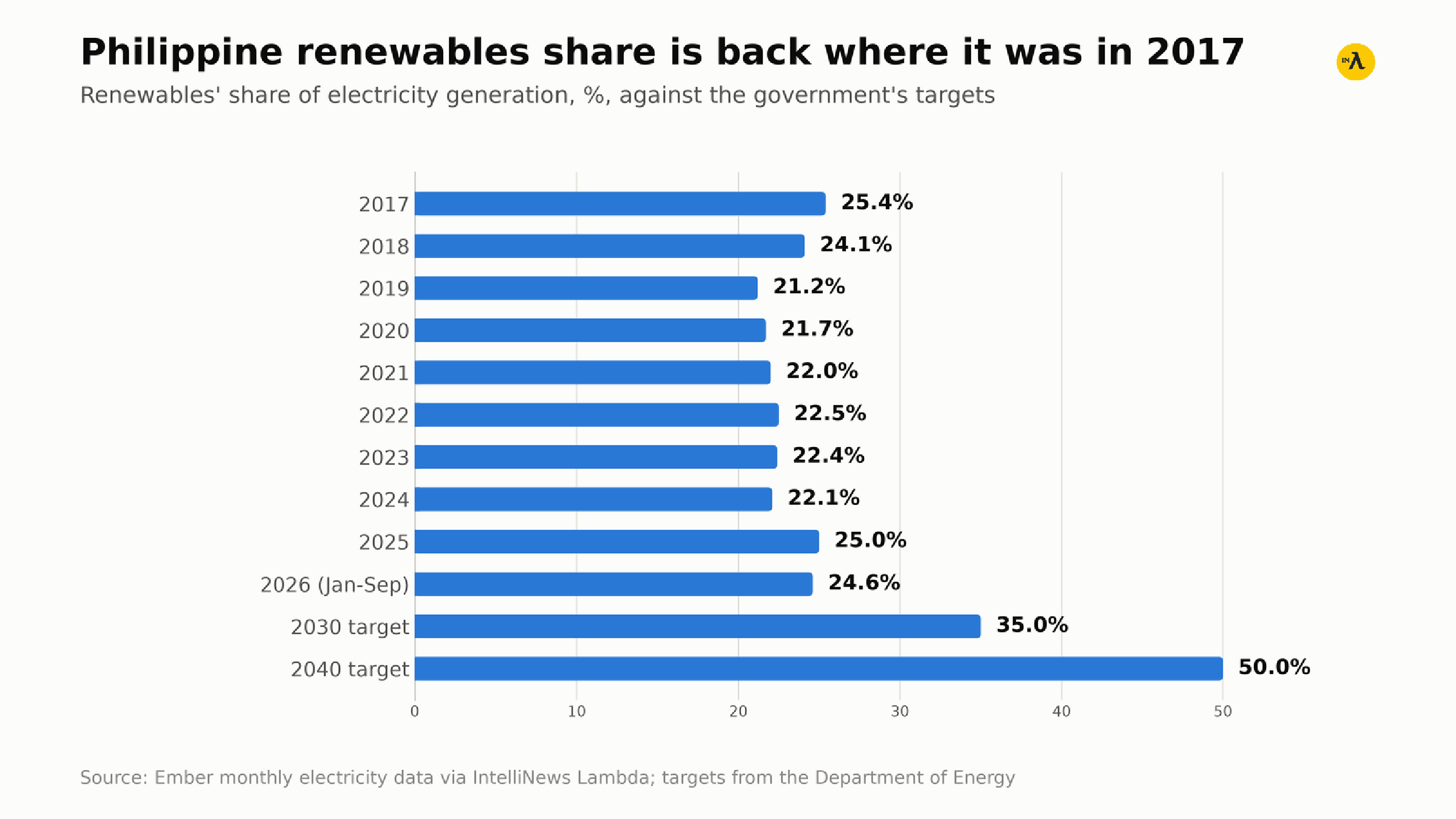
Renewables' share of Philippine electricity generation against the government's targets, %. Source: Ember monthly electricity data via IntelliNews Lambda; targets from the Department of Energy
The 12 contracts given up by ACEN, the Ayala group's energy arm, disclosed to the Philippine Stock Exchange on November 11, include the 1,248 MW Manila Bay and 1,024 MW Calatagan offshore wind projects and the 823 MW Masinloc solar farm. None had reached a final investment decision. The company framed the exit as a move from rapid expansion to execution and capital efficiency, and said it fitted the regulator's own clean-up. Two of its units had already handed back 486 MW of solar in September over land problems.
Garin's target is the speculator rather than the struggling builder. “What we don’t want are those that are getting contracts without properly studying the projects,” she said. Those holders, she added, were “simply holding on to the contracts and selling them when an interested buyer comes along”.
By July 2025 the DoE had issued about 1,400 renewable energy service contracts covering some 130 GW of potential capacity. Over the past two years 163 contracts, worth nearly 18 GW, have ended, either surrendered by their holders or terminated by the department. The sweep began in 2024, when the DoE moved to cancel more than 100 stalled contracts, most of them awarded between 2017 and 2019, and in 2025 it revoked 84 covering about 5.3 GW.
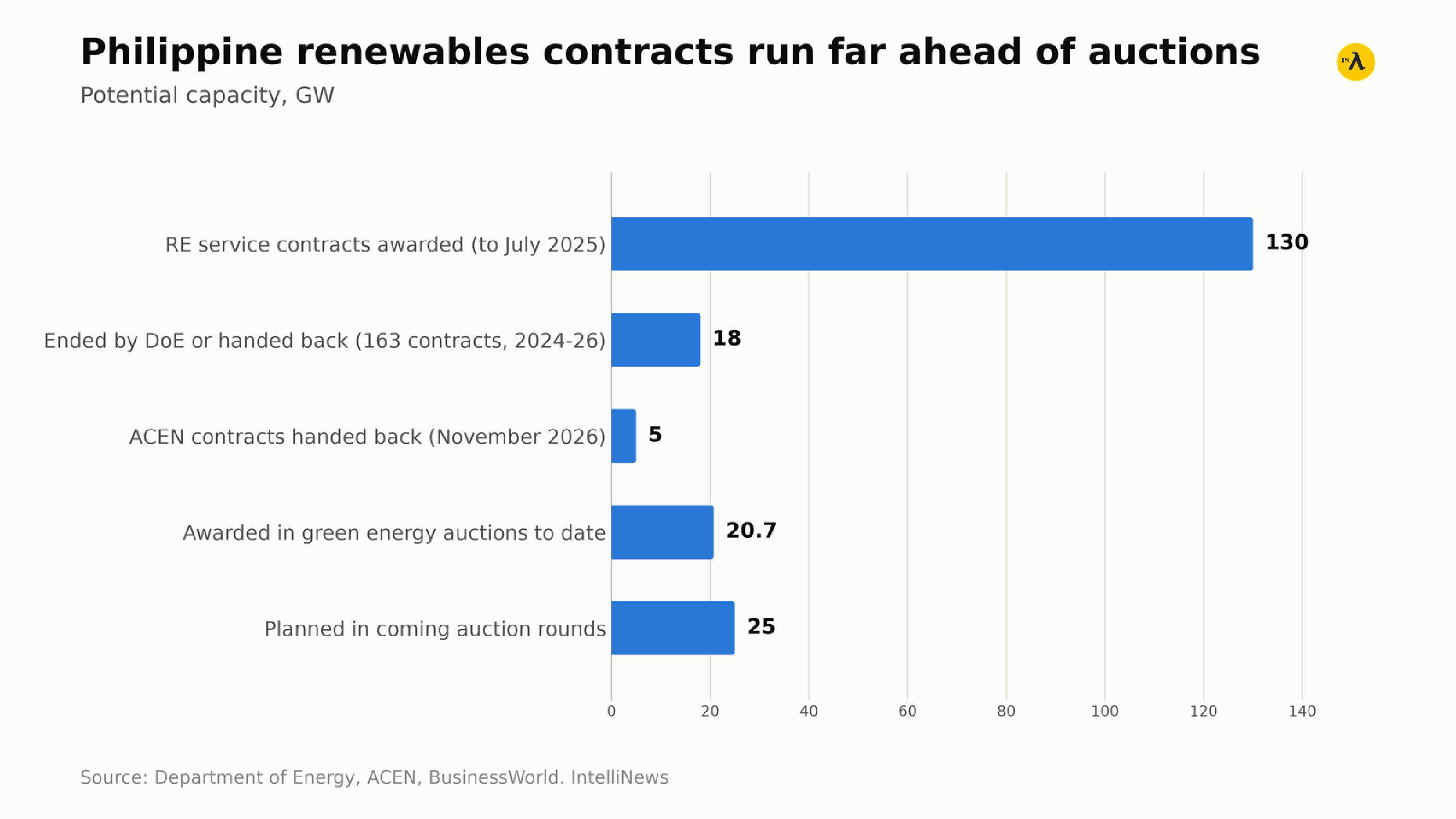
Potential capacity of Philippine renewable energy contracts and auctions, GW. Source: Department of Energy, ACEN, BusinessWorld; IntelliNews
Whether the clear-out turns out to be housekeeping or a warning depends on who picks up the vacated sites, and how fast. Energy Assistant Secretary Mandy B. Romero said other developers were ready to move in. “This isn’t a setback and it’s a part of the regulatory enforcement responsibilities of the Department of Energy to protect consumers,” she said.
Auctions, rather than open-ended licences, now carry the load. The government has lined up 25 GW for green energy auction rounds, including the country's first fixed-bottom offshore wind round, on top of the 20.7 GW already awarded in the first rounds. Some of those earlier awards were caught in the same crackdown on non-performing contracts.
Money is not the obvious constraint. Renewable projects took PHP745.10bn ($11.7bn), or 79% of investment approvals by the Board of Investments in the first nine months of 2026, after 13 projects worth PHP344.62bn ($5.4bn) won Green Lane fast-track status in the first five. Manila also adopted more clean energy policies than any other big Southeast Asian economy between February and August, and it has every political reason to keep plants moving after rotational blackouts and soaring power bills in the spring.
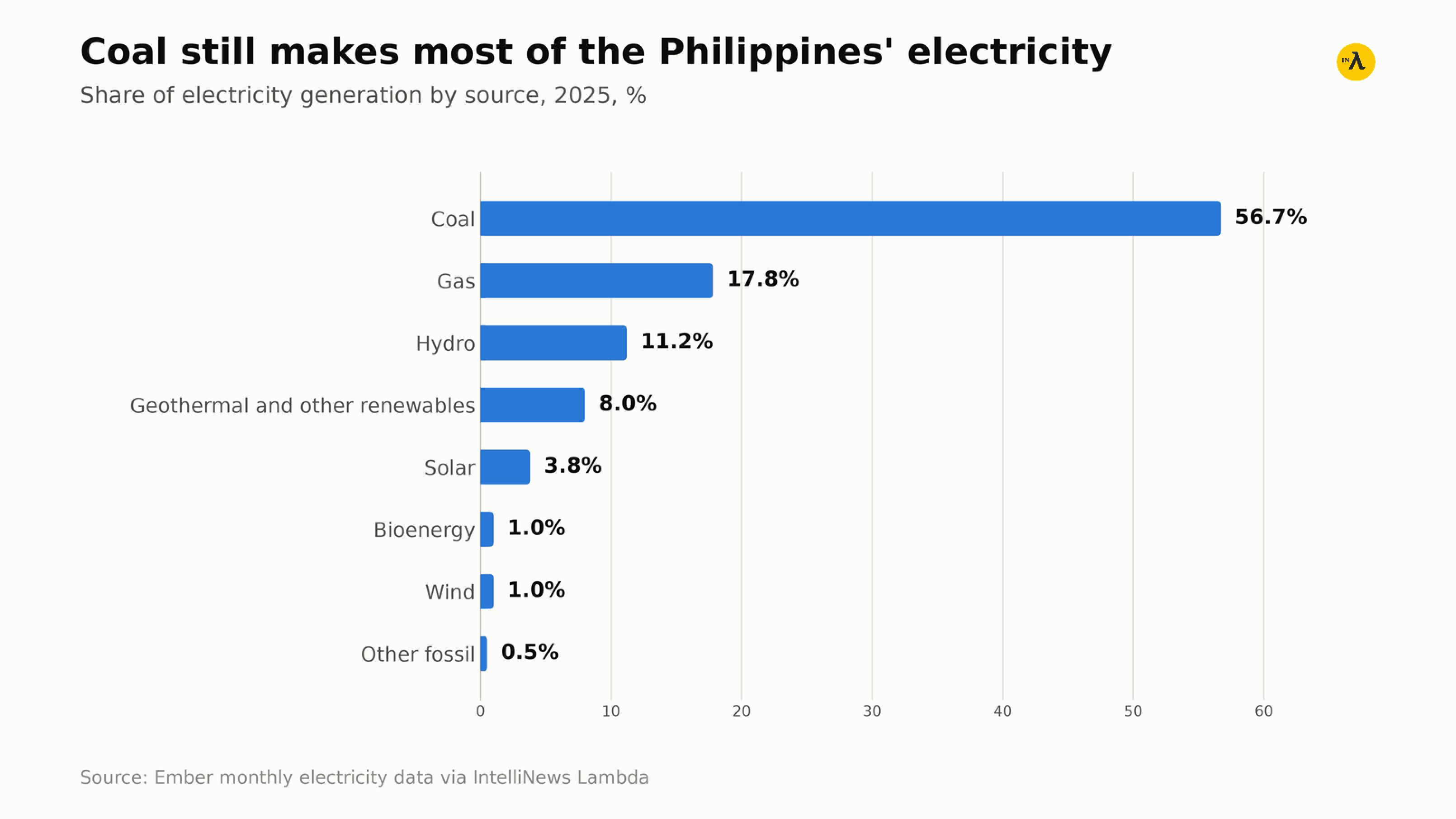
Share of Philippine electricity generation by source, 2025, %. Source: Ember monthly electricity data via IntelliNews Lambda
Developers back the purge but want it aimed carefully. “The DoE canceling nonmoving and noncompliant RE service contracts is a good signal that the DoE is firm in ensuring that RE projects are implemented,” Jose M. Layug, a former energy undersecretary who now heads the Developers of Renewable Energy for AdvanceMent, told BusinessWorld.
“At the same time, DoE needs to balance its clean-up efforts with helping out legitimate and serious contractors who face legitimate development struggles due to force majeure issues like delays in permits and registrations,” he added. Layug believes the targets are still achievable if the government stays fully committed.
His caveat is the weak point in the ministry's case. The DoE itself names permitting and grid connection as the main barriers to getting approved projects built, and a developer stalled by a slow permit office looks, on a contract register, much like one sitting on a licence to sell it. Solar's share of generation has climbed from 3.0% in 2024 to 5.4% so far this year, Ember's figures show, so the building has started. The clean-up will be judged on whether turbines and panels rise before 2030 on the sites ACEN and others have walked away from.
This article was produced with the help of the IntelliNews Lambda analytical tool
Follow us online