
Singapore and Indonesia take Europe's wind power ashore

The steel platforms that will bring North Sea wind power ashore in the Netherlands and Germany are being built in Singapore and Indonesia's Batam, CNA reports.
Seatrium, the Singapore-listed offshore engineering group, is fabricating high-voltage direct current (HVDC) converter platforms for TenneT, the Dutch state-owned grid operator. Each weighs about 30,000 tonnes, roughly as much as three Eiffel Towers, and can carry up to 2GW, enough for around 1.5mn homes. About 2,000 people are at work on the three commissioned projects across the two yards.
The orders put Asian shipyards at the narrowest point of Europe's energy transition: the converters, cables and onshore links that carry offshore power to customers. Europe's power bottleneck has moved from generation to the grid, and grid constraints now threaten the bloc's energy security goals.
Maarten Abbenhuis, TenneT's chief operating officer, said the availability of skilled workers and the size and quality of the yards were among the reasons for going to Singapore and Batam. "For us, the driver is the technical capability to manage the two-gigawatt standards," he said.
The work runs under a five-year framework agreement TenneT signed in March 2023. Seatrium holds three Dutch platforms, IJmuiden Ver Beta, IJmuiden Ver Gamma and Nederwiek 2, each valued at about €2bn, according to the company's June 2024 statement. In December 2025 a consortium of Seatrium and GE Vernova added BalWin5, a 2.2GW platform for TenneT's German grid due to be commissioned in 2032, with most of the fabrication again in Singapore and Batam.
TenneT and the Dutch state plan to invest €43bn over the next five years to keep grid expansion in step with new generation, CNA reports. "To distribute all this generated wind energy throughout the European continent requires onshore investment," Abbenhuis said.
Wind already meets around a fifth of Europe's electricity demand. Around the North Sea its share of generation has climbed fastest in the Netherlands, from 6.9% in 2015 to 24.4% in 2025, according to Ember data, and has risen in every country on the basin.
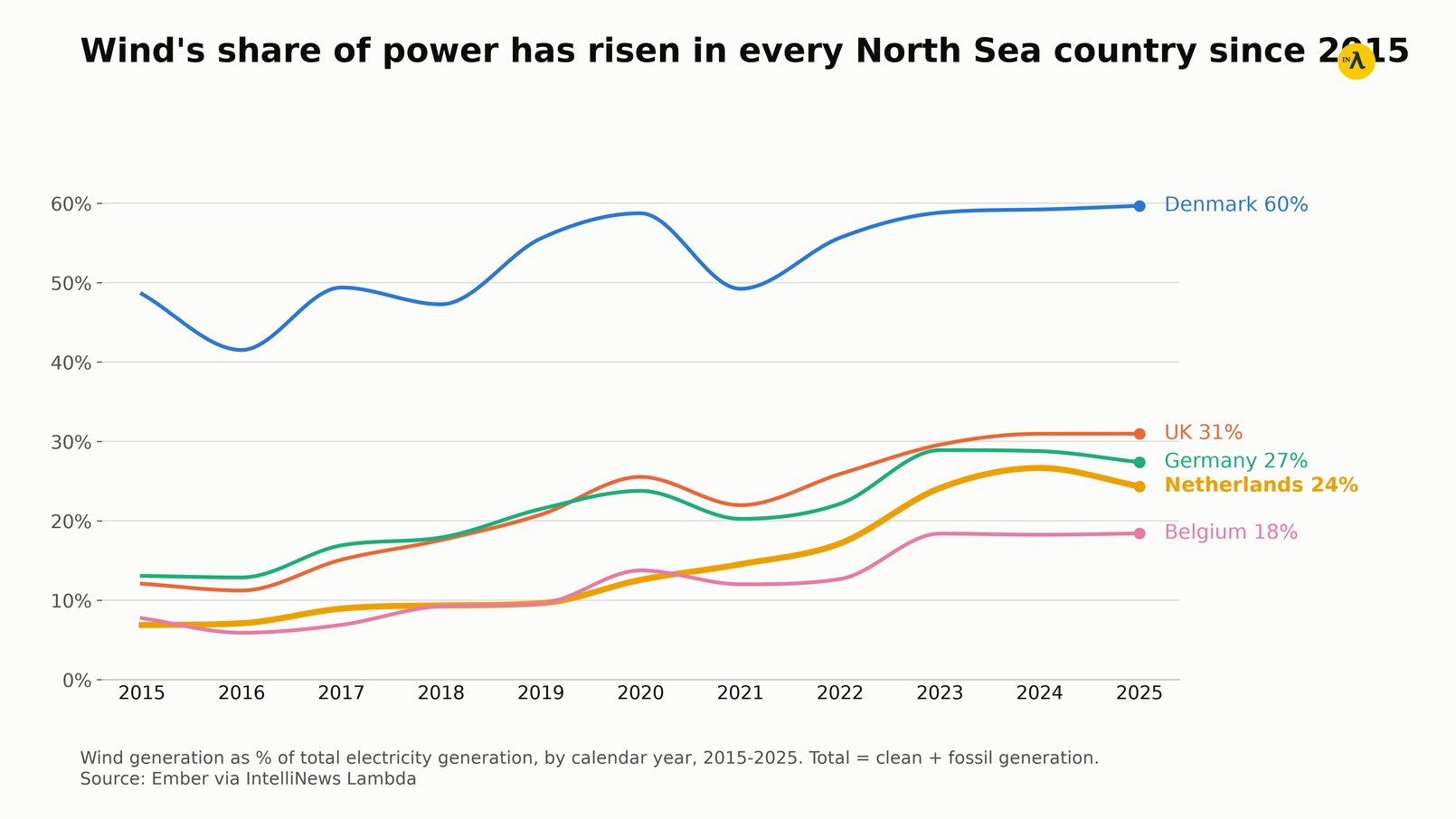
Wind generation as % of total electricity generation, by calendar year, 2015-2025. Source: Ember via IntelliNews Lambda
Europe installed 19.1GW of wind capacity in 2025, taking the total to 304GW, according to WindEurope's annual statistics. Only 2GW of that was offshore, the least since 2016. On the industry body's own outlook the EU will add about 22GW a year to 2030 and reach 343GW, well short of its 425GW target.
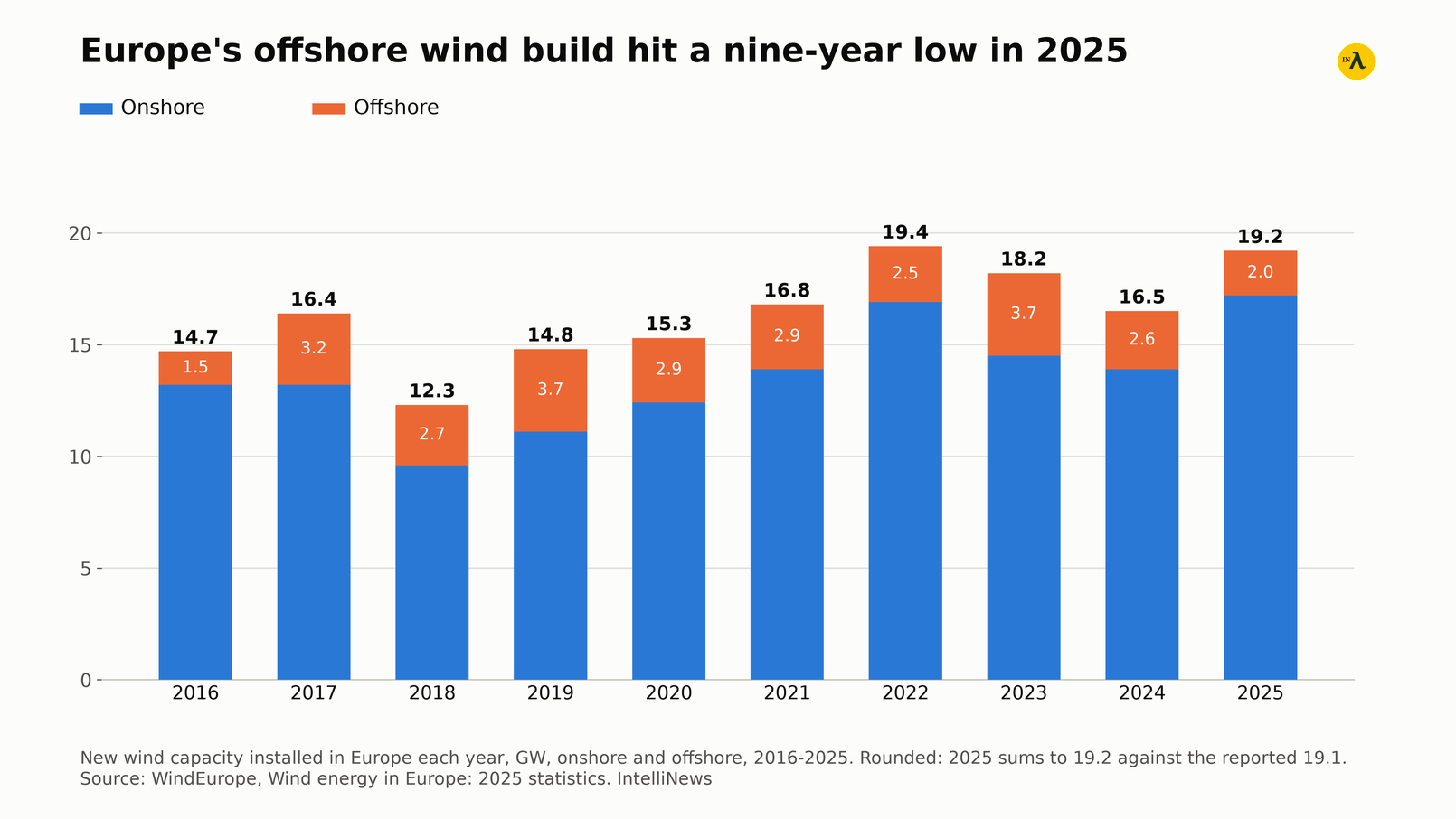
New wind capacity installed in Europe each year, GW, onshore and offshore, 2016-2025. Source: WindEurope. IntelliNews
The platforms convert the turbines' alternating current to direct current, which loses less power over long subsea cables, and a station on land converts it back before it enters the grid. "Two-gigawatt platforms are made to really bring very, very large renewable powers onshore," said Stefan Hartge, global accounts leader for grid systems integration at GE Vernova.
For Seatrium the grid contracts sit alongside its older oil and gas trade; it won a $156mn floating production vessel deal from SBM Offshore this month.
Chief executive Chris Ong credited Singapore's supply chains. "The maritime ecosystem, the offshore ecosystem that we have does help us a lot," he said.
Batam too gets a share of the skills and the payroll. Investment in the free trade zone reached IDR38.97 trillion ($2.13bn) in 1H26, 55.7% of the full-year target of IDR70 trillion, the zone authority BP Batam said, RRI reports. Singapore put in IDR10.89 trillion of that, more than a quarter.
Other projects on the island include a $500mn US tech manufacturing hub. Jakarta and Singapore are also working on 3.4GW of low-carbon power exports from Indonesia to Singapore by 2035.
The yards building Europe's clean-power grid sit in a region that still burns coal for almost half its electricity, and where new demand is being added on top of coal rather than displacing it, CNA reported in a separate piece the same day.
Abbenhuis made the case for demand at home in Europe. "That momentum is now for us to be able to distribute all the offshore wind, the industry needs to electrify now," he said. The same arithmetic holds in Southeast Asia. Exporting grid hardware to the North Sea brings Batam and Singapore orders and skills, but the transmission lines and the factories to use clean power at home are a separate job, and the order book does not do it for them.
This article was produced with the help of the IntelliNews Lambda analytical tool
Follow us online