

South Korea's Samsung Heavy signs up a US reactor maker for the first nuclear-powered LNG carrier

IntelliNews summary:
• Tesser's Triton reactor runs on TRISO fuel with low-pressure molten salt coolant and can take on fuel while operating.
• Samsung Heavy won ABS approval in principle in 2025 for a 174,000 cubic metre carrier with a 100MWt KAERI-designed reactor.
• The 234 LNG carriers due in 2026-2030 could carry 158mn t/yr at most, against 229mn t/yr of sanctioned export capacity.
• The IMO is scheduled to resume its adjourned Net-Zero Framework session on December 4.
____________________
South Korea's Samsung Heavy Industries (KRX:010140) has paired exclusively with Texas-based Tesser Atomics to develop a nuclear-powered liquefied natural gas (LNG) carrier for the transatlantic trade.
Under a memorandum of understanding signed in Norway on November 19, the Korean yard becomes Tesser's sole shipbuilding partner and Tesser the yard's sole reactor partner for a demonstration vessel, the two companies said in a joint announcement. Samsung Heavy takes the hull: design, systems integration and construction. Tesser brings the reactor and is responsible for getting it licensed. They describe a path from concept checks to a demonstrator and then repeat orders, with the first ship expected to trade commercially between the US and Europe.
Reactors at sea have so far driven warships and Russia's Arctic icebreakers, and almost nothing that earns its living hauling freight. Whether a gas tanker becomes the first commercial exception will be decided by flag states, class societies, insurers and ports. On that reckoning the licensing half of this deal may matter more than the steel.
Fuel while you sail
Tesser's design, called Triton, is a compact fluoride-salt-cooled high-temperature reactor (FHR). It runs on TRISO fuel, carries its heat away in molten salt at low pressure and can be refuelled while operating. Per Peterson, Tesser's co-founder and chief executive, also co-founded Kairos Power, which is keeping its version of the technology for grid electricity while Tesser takes it to sea.
"Our reactors use TRISO, a proven fuel the U.S. Department of Energy spent more than two decades developing. They refuel while they run, so owners can choose when they want to buy new fuel," Peterson said.
The tie-up has Norwegian parentage. It began in NuProShip, a research programme that screened reactor types for merchant ships, and continues inside SFI SAINT, a consortium led by the Department of Ocean Operations and Civil Engineering at the Norwegian University of Science and Technology (NTNU) and backed by the Research Council of Norway. Kyunghee Kim, who heads Samsung Heavy's Future Business Division, set out the commercial test: "we aim to prove that a nuclear-powered merchant ship can be deployed on a commercial trade route and give shipowners the evidence they need to choose nuclear propulsion for their next generation of vessels."
Third design, same cargo
In September 2025 it won approval in principle from the American Bureau of Shipping (ABS) and the Liberian flag for a 174,000 cubic metre carrier driven by a molten salt reactor it had developed with the Korea Atomic Energy Research Institute (KAERI). That unit was rated at 100MWt and designed to last the ship's whole life without refuelling, World Nuclear News reported, quoting KAERI calling the approval "the first step toward moving forward with actual ship development".
A year earlier ABS had modelled a high-temperature gas-cooled reactor on a 145,000 cubic metre carrier and found it would allow faster passages with no emissions, though the reactor would need replacing about every six years. A sealed core, a swap-out core and now a core topped up at will: three answers to the same question about who buys fuel and when. Owners raised on bunker markets are likely to find the last one the easiest to price.
Why the Atlantic
American cargoes made up 57% of Europe's LNG imports in 2025, and the Institute for Energy Economics and Financial Analysis (IEEFA) expects the US to supply two-thirds in 2026. Ships are short as well: the 234 newbuild carriers due between 2026 and 2030 could carry 158mn t/yr at most, against 229mn t/yr of export capacity that has reached a final investment decision.
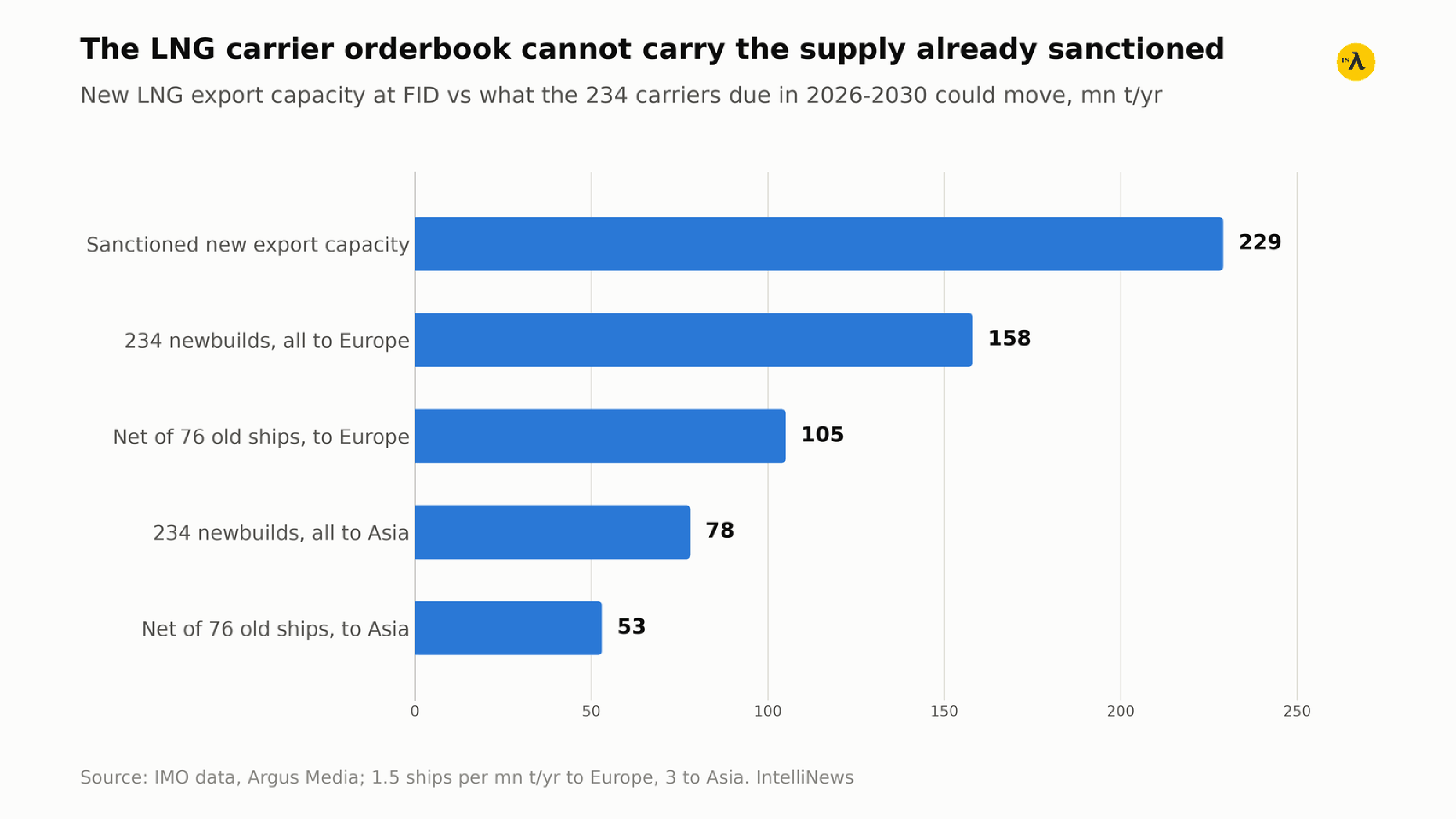
New LNG export capacity at FID against what the 2026-2030 newbuilds could carry, mn t/yr. Source: IMO data, Argus Media. IntelliNews
For a Korean yard the timing fits a wider hunt for business beyond standard hulls. Samsung Heavy appears to be furthest ahead in floating data centres, and Seoul has earmarked $150bn for shipbuilding co-operation with Washington within its $350bn US investment pledge. A US reactor in a Korean hull carrying US gas sits neatly inside that bargain.
Waiting on the rulebook
Shipping produced 1,056mn tonnes of CO2 in 2018, 2.89% of the global total, according to the Fourth IMO GHG Study. In July 2023 the International Maritime Organization (IMO) set a goal of net-zero emissions by or around 2050, but the rules meant to deliver it have stalled. In October 2025 member states adjourned for a year the session called to adopt its Net-Zero Framework, leaving owners weighing fuels such as ammonia without the fuel standards and incentives that would favour them. The marine environment committee meets from November 30 to December 3 and is scheduled, subject to confirmation at that meeting, to reopen the session on December 4, with nine countries proposing an alternative to its financial penalties.
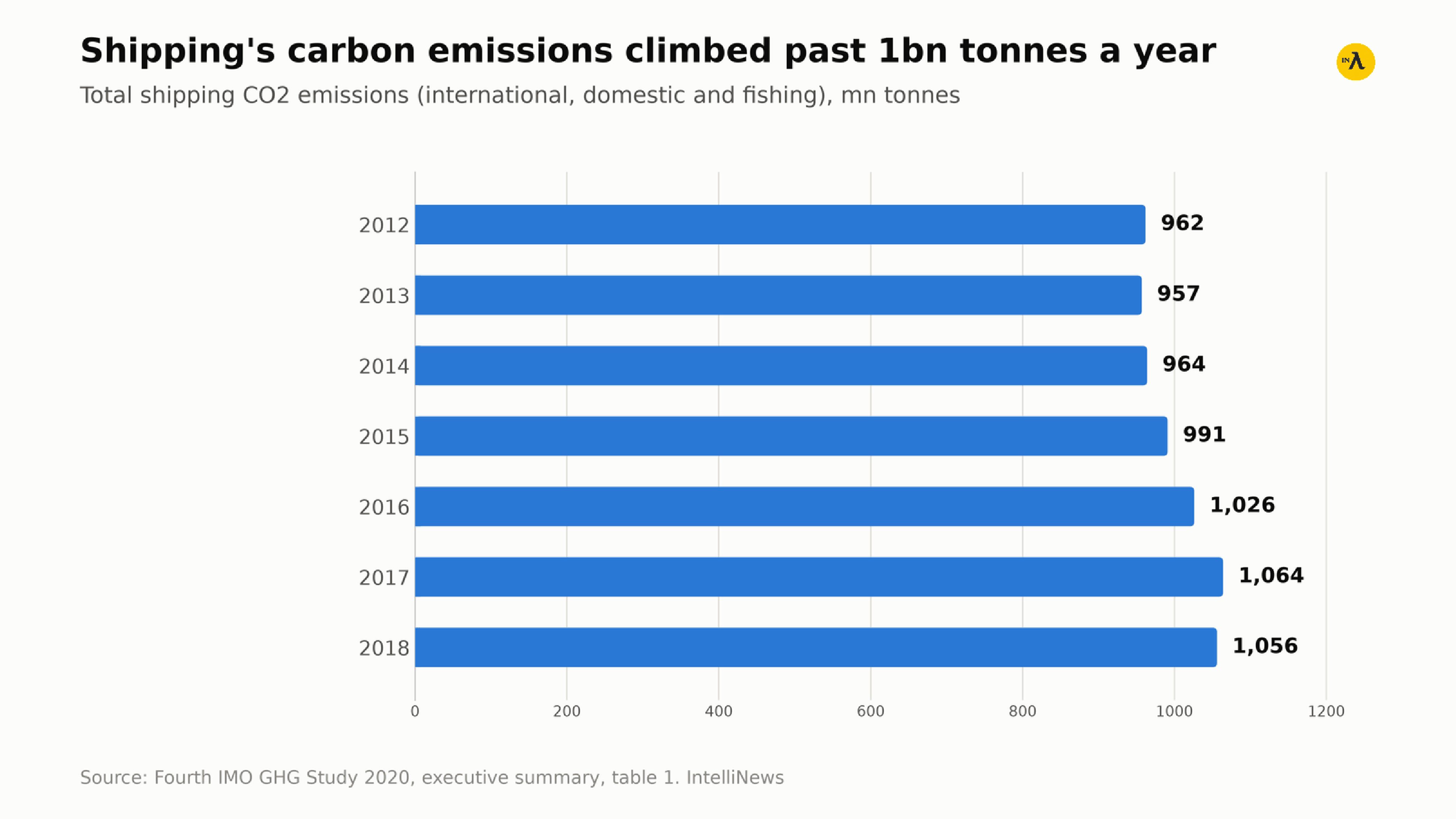
Total shipping CO2 emissions, mn tonnes, 2012-2018. Source: Fourth IMO GHG Study 2020. IntelliNews
The memorandum names no ship, date or budget, and neither company has given one. What it buys Samsung Heavy is first place in the queue if the regulators and the owners come round, and a working ship on the busiest LNG lane in the world would be harder for the IMO's negotiators to ignore than another study.
This article was produced with the help of the IntelliNews Lambda analytical tool
Follow us online