
Turkey begins offshore oil and gas exploration in Pakistan, plans drilling in 2027

IntelliNews summary:
• The first target is Indus-C block, where PPL estimates 1.5 trillion-2 trillion cubic feet of gas.
• Turkey imports 83% of its crude and 95% of its gas; its current account deficit was $30.1bn in 2025.
• Turkey has spent around $1 trillion on oil and gas imports in 20 years, says its finance minister.
• Pakistan has drilled only 18 offshore wells since 1947.
____________________
Turkey's seismic vessel Oruc Reis is to start searching for oil and gas off Pakistan, with drilling due in 2027, Energy Minister Alparslan Bayraktar said on November 20.
Bayraktar was at Karachi Port for a ceremony to welcome the ship, alongside Pakistan's Deputy Prime Minister and Foreign Minister Ishaq Dar and Petroleum Minister Ali Pervaiz Malik. Writing on X, he said Oruc Reis would run two- and three-dimensional seismic surveys in the Indus and Makran basins to "uncover the potential there". He called the step a "strong turning point" in energy ties between the two countries, arriving as it does at a time of turmoil on world oil and gas markets.
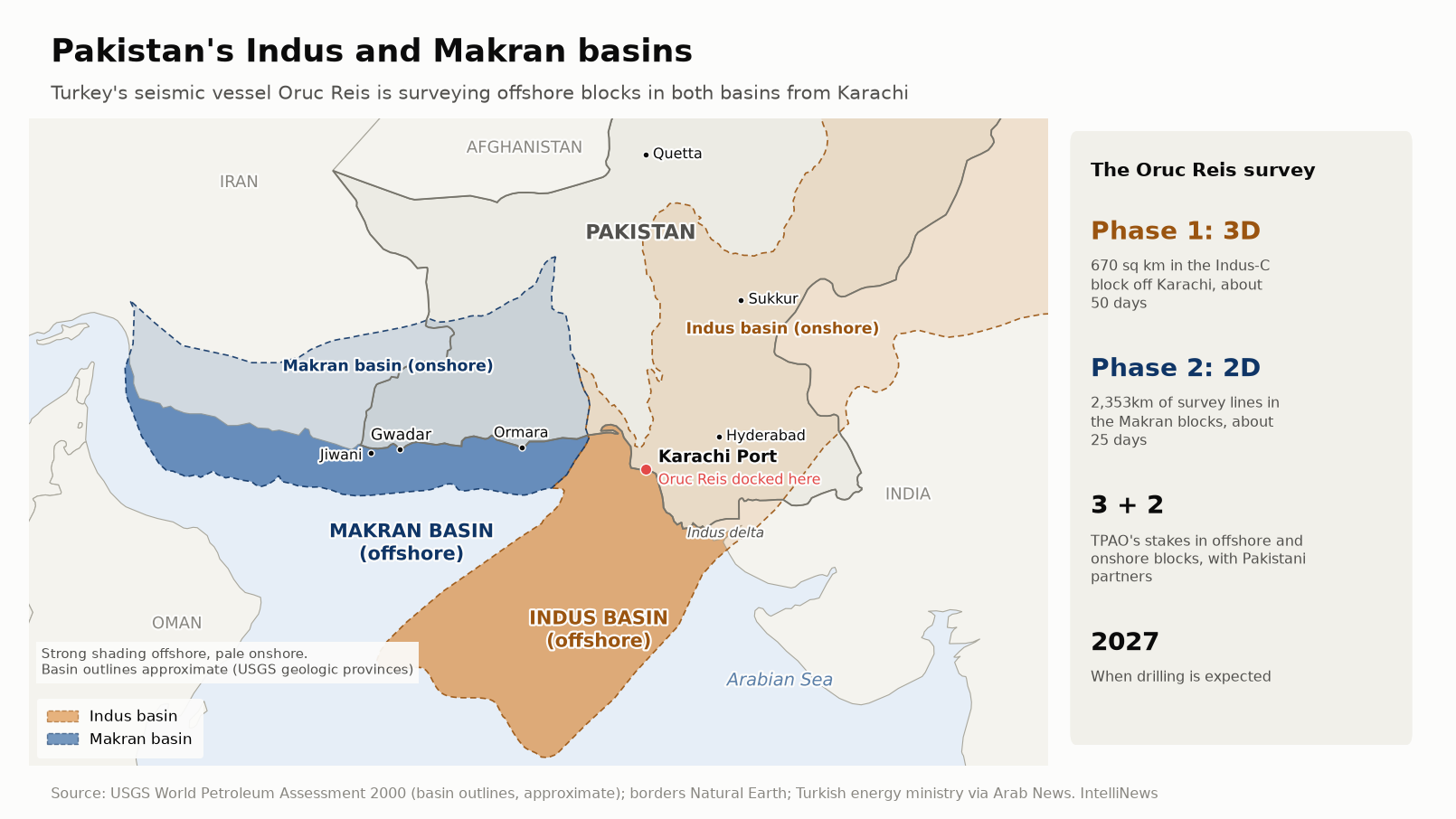
Pakistan's offshore Indus and Makran basins, where Turkey's Oruc Reis will run 3D and 2D seismic surveys from Karachi. Source: USGS World Petroleum Assessment 2000 (basin outlines, approximate); borders Natural Earth; Turkish energy ministry via Arab News. IntelliNews
The project fits Ankara's long effort to shrink an energy bill that is a major contributor to Turkey's chronic current account deficit. The country imports almost all the oil and gas it uses: 83% of its crude and 95% of its gas came from abroad, according to think tank Ember's analysis of Turkey's import dependence, and crude imports cost $16.1bn in 2025 with refined products such as diesel adding another $20bn.
The current account ran a deficit of $30.1bn, or 1.9% of GDP, last year, according to IMF data. Treasury and Finance Minister Mehmet Simsek warned this month that Turkey has spent around $1 trillion on oil and gas imports over the past 20 years and could face a similar bill over the next two decades if changes in energy policy are not introduced.
Ankara is attacking the bill on two fronts. One is the energy transition: wind and solar together generated 28% of Turkey's electricity in June 2026, and renewables made up 62.9% of installed capacity at the end of August. The other is raising the oil and gas Turkey controls itself, at home in the Black Sea's Sakarya gas field, where a floating production unit set sail in October to double output, and abroad, where state oil company TPAO is expanding exploration from Somalia to Pakistan.
TPAO signed exploration and production agreements in Pakistan last year with Mari Energies, Fatima, OGDCL, PPL, Prime and GHDL covering three offshore and two onshore fields, after taking part in Pakistan's offshore bidding round alongside Pakistani state companies.
The first target is the Eastern Offshore Indus-C block, where TPAO's subsidiary Turkish Petroleum Overseas Company is operator with 25%, alongside PPL with 35%, OGDCL with 20% and Mari Energies with 20%, Dawn reported. The ship is to gather 3D seismic data across 670 square km there over about two months, and PPL estimates the block holds 1.5 trillion-2 trillion cubic feet of gas, according to the newspaper.
The vessel is then due to run a 2D survey along 2,353 km of lines in the Makran blocks, a job of about 25 days, according to the Turkish energy ministry figures carried by Arab News.
Bayraktar said in October that the planned operations off Pakistan had been held up by about six months by the war in Iran.
For Pakistan, the survey marks a revival of offshore exploration after years of neglect. Its 2025, offshore bid round, the first in 18 years, offered 40 blocks in the Indus and Makran basins and drew bids for 23 of them covering about 53,510 square km, Malik said at the ceremony. Only 18 wells have been drilled in Pakistan's roughly 300,000 square km of offshore waters since independence in 1947, he added.
Follow us online