
Baghdad wins a narrow Hormuz reprieve
Bowing to persistent Iraqi lobbying, Tehran has begun waving through select Iraqi crude tankers at Hormuz. It is a partial, politically freighted escape valve from six-month shipping paralysis
WHAT: Iran permits limited Iraqi tanker transits through a still-closed Strait of Hormuz.
WHY: Baghdad’s diplomatic distance from Washington earns preferential treatment from Tehran.
WHAT NEXT: Fresh US sanctions loom as dark-transit workarounds keep Gulf crude flowing.
Nearly six months after the US-Israeli air campaign against Iran began on February 28, the Strait of Hormuz remains the defining variable in the world oil market.
Traffic has collapsed, insurers have retreated, and the fiction of “business as usual” has been abandoned. Yet crude is still moving – some of it under Iranian sufferance, most of it under American guns, and almost all of it invisible to the ship-tracking screens on which the market has come to rely.
The concession to Baghdad, reported on August 22 by the state news agency IRNA, is the first meaningful softening of Iran’s de facto closure of the waterway. Iraqi President Nizar Amidi, speaking at the Baghdad Dialogue policy conference, confirmed that Tehran had facilitated the passage of “some ships carrying Iraqi oil in the strait” in recent days, and that talks were continuing over what he termed “complex problems” in the strait.
The permissions were, according to IRNA, among the principal requests carried to Baghdad by Iranian parliament speaker Mohammad Bagher Ghalibaf during his visit earlier in the week.
A reward, not a thaw
The gesture is narrow and conditional. Mostafa Khoshcheshm, a professor at the University of Applied Sciences in Tehran, told Al Jazeera that Iran had chosen to let Iraqi cargoes through because Baghdad has “always stood up to the United States”, and that Tehran was simultaneously seeking to “punish Gulf states” it accuses of hosting the American basing that enabled the February strikes – an accusation those states deny.
“Iran has requested other states to do the same [and] stop the US from using their territory,” Khoshcheshm added.
Amidi, for his part, was at pains to distance Iraq from the wider conflict, telling the conference that his government would not accept Iraqi soil being used to launch attacks against neighbours, and that “everyone is keen to prevent Iraq from being dragged into the ongoing war in the region”. The repercussions of that war, he added, “have been harsh on our country”.
Iraq was producing roughly 4mn barrels per day before hostilities began. Prime Minister Ali al-Zaidi said on August 21 that Baghdad was working to expand exports through Turkey’s Ceyhan terminal and to open new outlets via Syria’s Baniyas port and Jordan’s Aqaba – an infrastructural pivot that reflects how thoroughly the Hormuz route has ceased to be reliable.
Al Jazeera’s Tohid Asadi, reporting from Tehran, characterised the wider picture as a “holding pattern that applies not only to Iraqis but also all countries”. Iranian talks with Oman on reopening arrangements had made what Tehran calls good progress, he said, “regardless” of which “no deal has been reached”. The Iranian position, Asadi added, is that “as long as the naval blockade continues, the strait is going to remain closed”.
The dark corridor
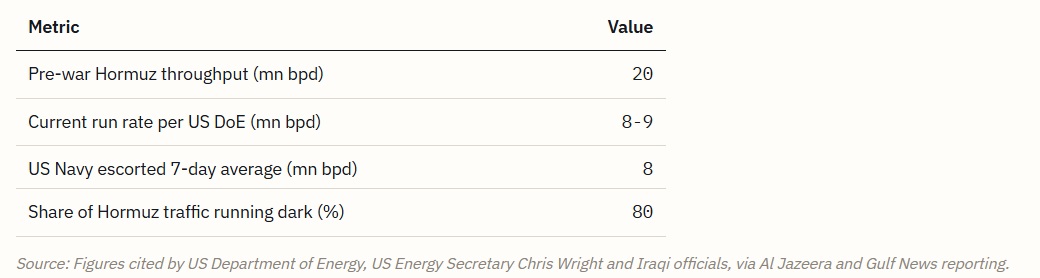
While the diplomatic weather has hardly shifted, the physical flow of crude has quietly adapted. According to shipping analytics firm Kpler, roughly 80% of Hormuz traffic over the past fortnight has been transiting with Automatic Identification System (AIS) transponders switched off, hugging the Omani coast as far from the Iranian shore as geography permits.
The tactic is being coordinated, in many cases, with the US Navy, which is escorting vessels through a southern corridor. US Energy Secretary Chris Wright said the American military had helped move a seven-day average of 8mn bpd through the strait – down from more than 20mn bpd before the war, but far above what transponder-based tracking suggests.
The Department of Energy puts the current run rate at 8–9mn bpd, roughly double the figure implied by AIS data alone.
The mechanics were captured in the journey of the Greek-owned supertanker Kiku, described by Gulf News. After loading at Qatar’s Mesaieed terminal, the vessel was sailing off Dubai on July 31 when its AIS signal vanished; at 10am the following day it reappeared beyond the strait, having completed a night-time “dark” transit under US protection.
CNN observed more than a dozen ship-to-ship transfers over two days in the Gulf of Oman, with cargoes onward-bound to China, Taiwan, South Korea, the Philippines, Vietnam and Thailand. Satellite imagery from August 14 showed vessels physically present on the Omani side of Hormuz that did not appear in MarineTraffic feeds at all.
The irony is not lost on anyone. For years, Iran’s own sanctions-evading “dark fleet” pioneered exactly these techniques – disabled transponders, spoofed positions, mid-sea transfers. Those methods are now being deployed against Tehran, with the world’s most powerful navy providing the escort.
Sanctions escalation
Against that backdrop, Washington is preparing to tighten the financial screws further. US Treasury Secretary Scott Bessent will hold a press conference at 1800 GMT on August 24 to announce what he has previewed as “the toughest sanctions in history” on Iran.
Bessent has publicly urged cooperation from China, which according to 2025 Kpler data absorbs more than 80% of Iran’s seaborne crude exports. Beijing has responded by calling for diplomacy.
Tehran’s reaction has been sharp. Foreign Ministry spokesperson Esmaeil Baghaei, writing on X, described the imminent package as an “assertion of extraterritorial sovereignty over every independent member state of the United Nations”, arguing that “such secondary sanctions find no foundation in international law”.
Mohsen Rezaei, secretary of Iran’s Supreme National Security Council, told state television: “We are telling all nearby countries not to join the US economic war, otherwise we will consider them as enemies.”
President Donald Trump, who has threatened economic consequences against any country providing “any type of lifeline to Iran”, said on August 21 that Washington was watching “what happens” in the conflict. Iran, he added, “would love to make a deal, but they’re not ready to make the right deal, in my opinion”.
Iran’s own President Masoud Pezeshkian, quoted by ISNA on August 21, struck a rare conciliatory note: “It would be better to end the war today, when we are powerful and have dignity.”
Hardening targets
Meanwhile, downstream infrastructure across the southern Gulf is being physically fortified. The UAE has completed installation of steel-and-mesh “cope cages” over fuel storage tanks in Abu Dhabi and near Dubai International Airport, according to widely circulated imagery.
The four-month programme, begun in May, followed Iranian drone strikes on the Port of Fujairah and the Habshan gas facility, and a direct hit on a Dubai airport fuel tank on March 16. UAE air defences reported engaging 551 ballistic missiles, 29 cruise missiles and 2,265 unmanned aerial vehicles during the conflict.
For the market, the equilibrium is uneasy but functional: Iraqi barrels moving on Iranian goodwill, Gulf barrels moving under American escort, and a shadow economy of switched-off transponders keeping the wheels turning. The equilibrium’s fragility is its defining feature – a single miscalculated escort, a single missed drone, a single Chinese buyer capitulating to secondary sanctions could unwind it. Baghdad’s small victory is, for now, the closest thing to good news the region has produced since February.
Follow us online