
Egypt’s gas imports reach 43% of supply as output sinks 45% below 2021 peak

Egypt produced 42.4bn cubic metres (bcm) of gas in 2025, 40% below its 2021 peak, and output fell a further 8.5% y/y in January–August, according to the JODI-Gas World Database.
The gap has been filled from abroad. Imports of liquefied natural gas (LNG) rose 87% y/y to 13.1bcm in the first eight months of the year, as much as Egypt bought in the whole of 2025, while pipeline gas from Israel added another 6.4bcm. Together they covered 43% of Egypt’s gas supply in January–August, against 6% in 2021, when Egypt was still exporting LNG at scale.
“The extensive decrease in domestic gas production has prompted Egypt to seek gas from its neighbors and the LNG market. And the appetite is increasing,” Ira Joseph, a senior research scholar at Columbia University’s Center on Global Energy Policy (CGEP), wrote on X this week in the third of a series of posts on Egyptian gas. His chart, based on S&P Global data, shows output falling from about 186mn cubic metres a day (mcm/d) in 2021 to about 112mcm/d in 2025, with LNG and pipeline imports together approaching 60mcm/d.
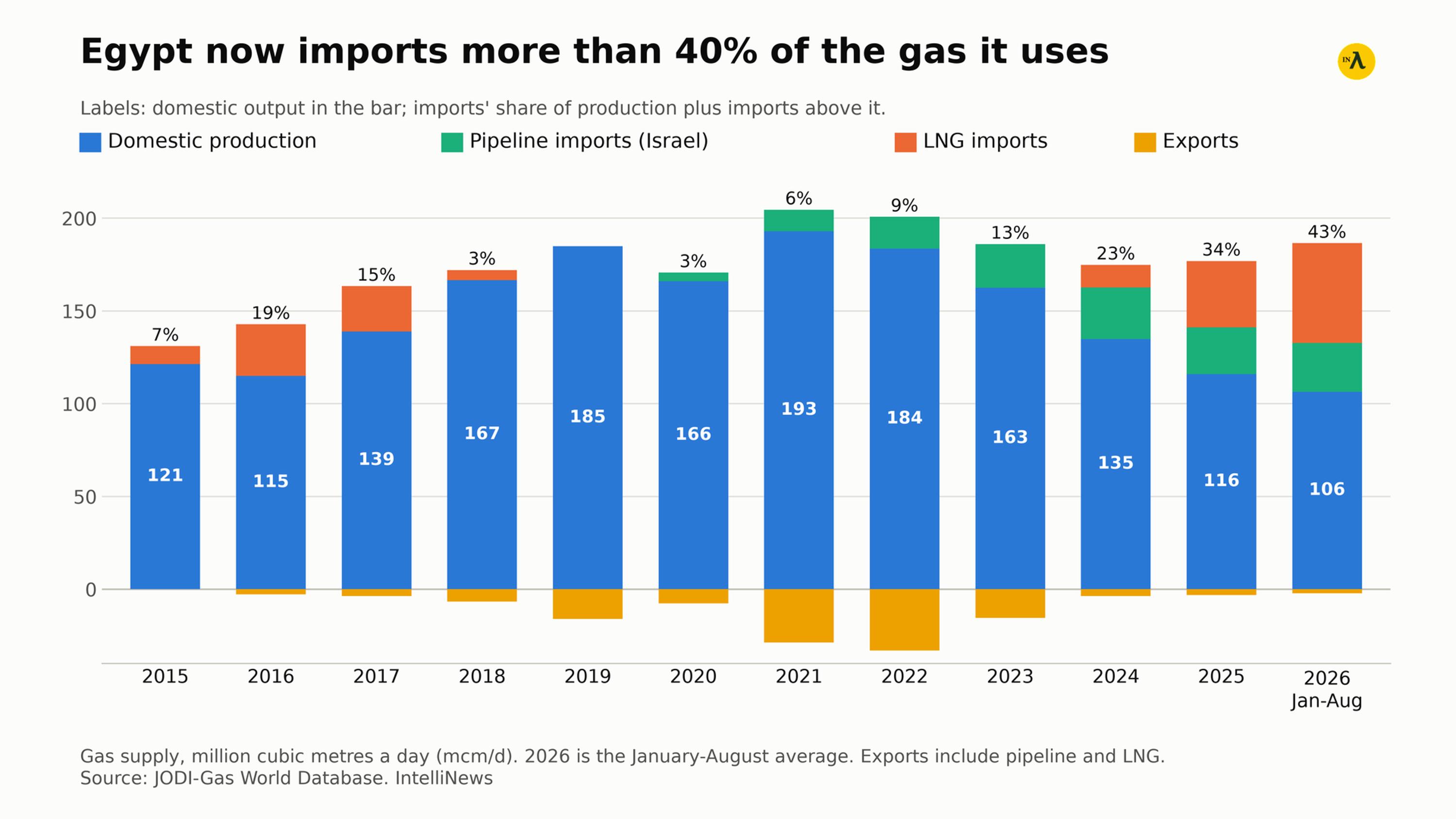
The JODI figures show the same turn. Output averaged 106mcm/d in January–August, down from 193mcm/d in 2021, while LNG imports averaged 54mcm/d and Israeli pipeline gas 26mcm/d. In August Egypt produced 3.19bcm, 48% less than in August 2021. LNG imports hit a monthly record of 2.30bcm in July, during the summer peak in power demand. Demand in the first eight months was 9.1% higher than a year earlier.
Egypt still ships the occasional cargo, as Joseph pointed out. JODI records LNG exports of 212mn cubic metres in January and 106mn cubic metres in February, roughly three cargoes, and none from March to August. In 2022 Egypt exported 11.3bcm of LNG, mostly to Europe, as it sold gas into the price spike that followed Russia’s invasion of Ukraine. An Egyptian official said on November 2 that an export cargo to Europe was being prepared at the Idku plant, run by Shell (LSE:SHEL) and Malaysia’s state-owned Petronas, for the end of November, provided supplies remained available after domestic demand was met.
The reliance on Israel carries its own risk. Israel halted gas exports to Egypt on February 28 after the US-Israeli strikes on Iran, and JODI shows pipeline imports collapsing to 161mn cubic metres in March from 736mn cubic metres in February before recovering. Capacity is rising under the $35bn Leviathan supply deal: NewMed Energy (TASE:NWMD) has completed a pipeline that raises capacity on the direct EMG link to Egypt from 6.5bcm to 8.5bcm a year, and Leviathan’s committed supply is due to rise from 4.7bcm to 6.7bcm a year once the deal’s conditions are met. Israeli gas also reaches Egypt through Jordan.
The bill is rising. Egypt has budgeted about $10.7bn for LNG and pipeline gas imports in the 2026/27 financial year, against an estimated $8.5bn the year before. Gas supplies to industry have also been cut, with fertiliser maker MOPCO (EGX:MFPC) facing a 33% reduction in allocations and Ezz Steel (EGX:ESRS) reportedly losing 30%.
Cairo is betting on new fields to turn the tide. Shell’s offshore Mina West field started up on November 15 and is expected to reach 160mn cubic feet a day (4.5mcm/d), and Eni (BIT:ENI) has begun start-up at its Meleiha Phase 2 hub, which can process up to 100mn cubic feet a day (2.8mcm/d).
Even at full rates the two would offset at most about 8% of the output lost since 2021. Cyprus’s Cronos field, due to start in 2028, will use Egypt’s Zohr facilities and Damietta LNG plant, but its gas is earmarked for export, mainly to Europe, so imports look set to stay high.
This article was produced with the help of the IntelliNews Lambda analytical tool
Follow us online