


Western majors lobbying Ukraine to stop attacks on CPC oil export route, says analyst

Ukraine risks alienating allies with attacks on oil infrastructure in Russia that is vital to Kazakhstan’s oil exports and economy and is used by Western oil majors, an analyst warned on December 8.
“It’s already clear that Western energy firms from countries allied with Ukraine are not happy about what is unfolding,” said Sergey Vakulenko, a senior fellow at think tank Carnegie Russia Eurasia Center, in a commentary looking at the ramifications of a naval drone assault that has substantially disabled the Caspian Pipeline Consortium (CPC) oil export terminal in Novorossiyska on Russia’s Black Sea coast.
He added: “The lobbying power of international oil companies is significant, and is already being directed toward convincing Kyiv to stop its attacks on the CPC. There was almost certainly a similar lobbying effort following the damage done to the CPC by drones earlier this year—so these energy companies likely believe Kyiv is now knowingly damaging their interests. Nor will these Ukrainian attacks increase sympathy for Ukraine’s cause in Kazakhstan.”
If Novorossiyska was to become a target under sustained attacks and became unusable as an oil export location, it could cost Kazakhstan and the majors tens of billions of dollars a year. But Vakulenko said it’s possible that Kyiv has calculated that striking the CPC “will demonstrate its resolve and readiness to take unpopular action to protect its interests. Perhaps Kyiv is trying to make other countries feel the consequences of the war, and, by doing so, push them into making more of an effort to help achieve peace. However, there’s no guarantee that the affected countries will push for a just peace, rather than simply a rapid end to the fighting”.
Amid a broader escalation of the Russo-Ukrainian war in the Black Sea, Ukraine attacked the offshore loading terminal of the CPC on November 29.
The damage caused, specifically to a single-point mooring (SPM) used for oil loading, is of far bigger concern to Kazakhstan – it exports around 80% of its shipped crude via Novorossiysk, with the shipments representing around 40% of its entire exports – than it is to Moscow – in 2024, Russian oil, produced in the North Caucasus, accounted for just 15% of the daily throughput of 1.2mn barrels that passed through the CPC pipeline to Novorossiyska, according to Vakulenko.
Astana, Kyiv in spat
The drone attack caused a spat between Ukraine and Kazakhstan. The Kazakhs warned the Ukrainians in an irate statement that such military action risked damaging bilateral relations, while Ukraine, in its response, accused Kazakhstan of not taking the principled stand that other countries have taken in condemning Russia for its attacks on civilians in Ukraine.
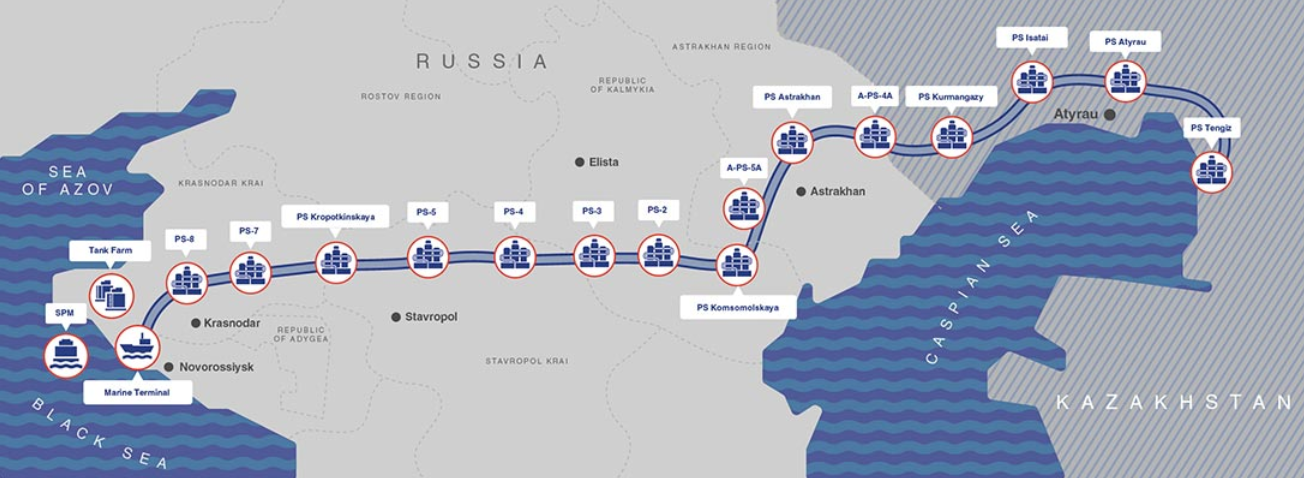
Around 80% of Kazakhstan's oil exports are reliant on the CPC oil pipeline and shipping facilities on Russia's Black Sea coast (Credit: cpc.ru).
While repairs are carried out at Novorossiyska, Kazakhstan is casting around looking at alternative routes for getting its oil to the world market. The choice is extremely limited, capacity-wise, but on December 8, Reuters reported sources as saying that Kazakhstan plans to supply 50,000 tonnes of crude to China directly from its giant Kashagan field in December for the first time. The crude will reportedly be exported to China via the Atasu-Alashankou pipeline, which runs to China’s Xinjiang province.
The oil is produced at Kashagan by the NCOC consortium, which includes China's CNPC and Japan's Inpex.
The Atasu-Alashankou pipeline runs from Kazakhstan to the Xinjiang region of China but usually carries oil from other fields in Kazakhstan.
Normally, most Kashagan oil is piped via the CPC route to Novorossiysk for shipping onwards.
"The incident at CPC's marine terminal did not lead to a complete halt in exports... The ministry, together with producers, is working to redistribute volumes and intensify the use of alternative routes," the Kazakh energy ministry told Reuters in a written statement.
Icy reaction from Turkey
As well as finding itself in a spat with Kazakhstan, Ukraine received an icy reaction from Turkey after it used naval drones to attack two tankers in part of the Black Sea that falls within the Turkish exclusive economic zone.
"Hopefully, this horrible war will end. But as of today also, we say to all the parties – Russia and Ukraine – to keep the energy infrastructure out of this war," Turkish energy minister Alparslan Bayraktar said on December 4.
"We need to keep the energy flows uninterrupted," he added, pointing out also that infrastructure routes like the CPC pipeline should not be seen as targets.
Analyst Vakulenko also observed in his commentary: “For Ukrainian commanders tasked with reducing Russia’s oil export revenue, the CPC might appear to be just another part of Russia’s oil infrastructure. However, damaging the CPC will cause more problems for some of Ukraine’s allies than it will ever do for Russia.
The Kazakh oil exported via the CPC is pumped from the Central Asian state’s largest oilfields: Kashagan as well as Tengiz and Karachaganak.
Said Vakulenko: “These fields are complex, expensive to develop, and operated by consortiums including the world’s biggest energy companies (ExxonMobil, Chevron, Eni, TotalEnergies, Shell, and others).”
He continued: “The Kazakh and Russian segments of CPC are owned by two companies: CPC-K and CPC-R, respectively. Their shareholders are mostly Western energy companies involved in oil production in Kazakhstan. However, Kazakhstan also owns 30 percent of the shares, Russian state-owned pipeline operator Transneft holds 24 percent, and small stakes are owned by Russian energy companies via joint ventures with Western firms.
“This complicated arrangement is explained by the fact that the point of the CPC is not to profit from transporting oil, but simply to ensure its owners can export crude from Kazakhstan and sell it on world markets.
“If the CPC were to stop working entirely, Russia would lose out on dividends and taxes from the consortium, and would need to pay to ship 200,000 barrels of oil a day from the North Caucasus to Novorossiysk by rail. In total, that would cost Russia an additional $600–$650 million a year. That is not insignificant, but it is far less than the approximately $27 billion a year that Astana and the Western firms operating in Kazakhstan would lose.”
Vakulenko concluded that another stoppage to the CPC would play into the Kremlin’s hands, saying: “It would make India, China, and Türkiye more willing to buy Russian oil (at less of a discount), and would send global oil prices higher, increasing the incentives for countries to evade Western sanctions. And Russia could insist that this was all the result of Ukraine’s actions.”
Follow us online