

Africa’s refinery boom draws billions while financing and crude-supply risks mount

Africa’s oil-refining sector is attracting billions of dollars in proposed investments, with Libya evaluating bids for a contract expected to exceed $600mn, Ghana planning a major expansion and Nigeria’s Dangote refinery drawing a reported $4.8bn in provisional IPO orders. However, financing gaps, crude-supply constraints and potentially weaker margins threaten the continent’s refining ambitions.
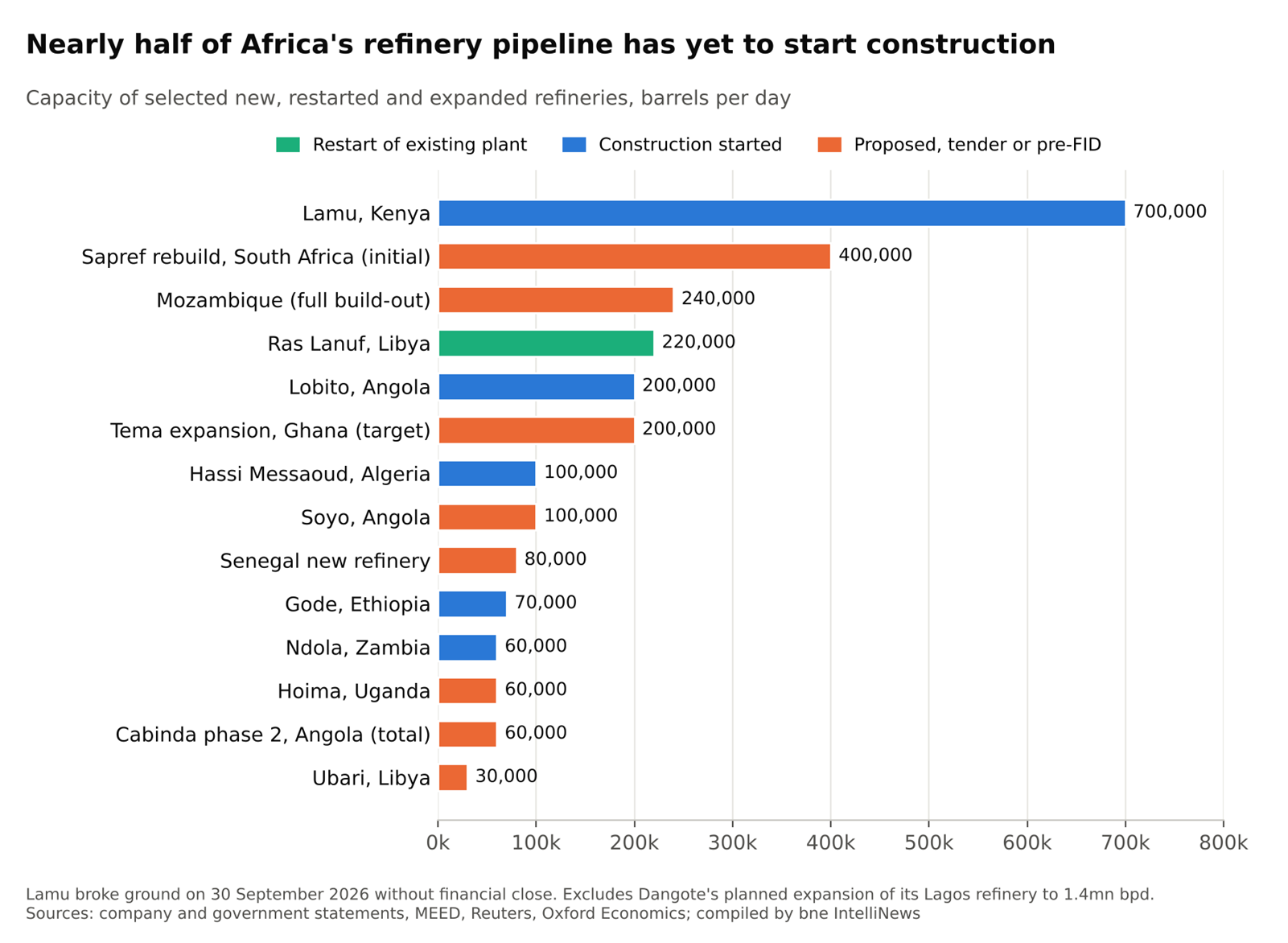
A new Oxford Economics Africa research briefing estimates that the continent’s installed refining capacity could reach 5.5mn barrels per day (bpd) by 2030 under its optimistic scenario, theoretically enough to meet projected petroleum-product demand. However, installed capacity measures how much crude refineries could process, not how much they will actually process. Its central scenario includes refineries already operating, restarted or under construction, while its optimistic scenario adds announced projects that have yet to enter full construction.
Compared with the central scenario, the optimistic forecast adds approximately 1.6mn bpd of potential refining capacity but only 400,000 bpd of additional actual output by 2030, as major projects including Dangote’s Nigerian expansion and Kenya’s Lamu refinery would still be ramping up.
The investment drive has intensified amid disruptions to Middle Eastern energy supplies. Oxford Economics estimates that the Middle East supplied 57% of Africa’s refined petroleum imports in 2025, leaving governments exposed to shipping disruptions and fuel-price shocks. No African country meets the 90-day net-import emergency stockholding benchmark applied to International Energy Agency member states, according to the briefing.
Africa’s refinery expansion increasingly depends on whether governments and developers can convert multibillion-dollar announcements into bankable projects. Although investment proposals now span the continent, many remain at the tender, financing or preliminary development stage. Even projects already under construction have not necessarily secured all the capital required for completion.
The funding gaps are substantial. Angola’s Lobito refinery, for which total cost estimates range from $6.2bn to $6.6bn, has absorbed $1.6bn so far, and state oil company Sonangol is seeking approximately $4.8bn in additional financing. Kenya’s proposed $16bn Lamu refinery has broken ground without confirmed financial close, while South Africa’s $7.15bn Sapref redevelopment remains before a final investment decision. Uganda’s $4bn Hoima project also awaits investment approval. Nigeria’s Dangote refinery is operational, but its $1.6bn IPO covers only a fraction of the cost of its proposed $14.3bn expansion.
Neither of Oxford Economics’ scenario classifications guarantees secured financing. Funding delays, construction setbacks and prolonged commissioning could therefore leave actual production well below nominal capacity, prolonging Africa’s dependence on imported fuels.
North Africa pursues new contracts and refinery restarts
Libya’s Zallaf Exploration, Production & Refining of Oil & Gas Company is evaluating engineering, procurement and construction (EPC) bids for its proposed 30,000-bpd South Refinery at Ubari. The contract is expected to exceed $600mn, with construction taking approximately 50 months, MEED reported on October 5. US-listed engineering group KBR (NYSE: KBR) secured a project-management contract in March, but the main EPC award remains pending. Oxford Economics excludes Libya’s Ubari project from its 2030 capacity scenarios because the main construction contract has yet to be awarded.
Libya is also pursuing refinery rehabilitation after its National Oil Corporation regained full ownership of the 220,000-bpd Ras Lanuf complex in May, taking back UAE-based Trasta’s 50% stake and ending a dispute that had kept the refinery idle since 2013. NOC chairman Masoud Suleman told reporters in May that rehabilitation would cost about $60mn and that the refinery could restart within six to 12 months, initially processing around 200,000 bpd.
Elsewhere in North Africa, Algeria’s state-owned Sonatrach is building a refinery at Hassi Messaoud with capacity of 5mn tonnes a year (roughly 100,000 bpd). The project, first contracted in 2020, was relaunched in 2024 when China’s Sinopec replaced South Korea’s Samsung Engineering alongside Spain’s Técnicas Reunidas in the EPC consortium, and is targeting the commissioning of its first units from late 2027.
Ghana seeks investors as Dangote raises capital
Ghana’s state-owned Tema Oil Refinery (TOR), which resumed crude processing in December 2025 after years of inactivity, announced on October 26 a programme to expand capacity to 200,000 barrels per stream day. The proposed 2026-2029 development combines an expansion of existing capacity from 45,000 to 85,000 barrels per stream day with a new 115,000-barrel-per-stream-day refinery.
TOR currently processes approximately 28,000 barrels per stream day and is seeking strategic partners for the expansion. “Refining Ghanaian crude in Ghana keeps value onshore,” managing director Edmond Kombat told the Ghana News Agency. Management is also considering a Ghana Stock Exchange listing to raise private and institutional capital, although no timetable or offering terms have been announced.
The possible listing forms part of efforts to restructure approximately $517mn in inherited debt, including about $120mn owed to the government, which Kombat said in September the finance ministry would write off. TOR management briefed a visiting International Monetary Fund delegation on the listing proposal, the Ghana News Agency reported on October 25.
TOR has received more than 5mn barrels of crude since May, compared with no deliveries in 2024, as IntelliNews reported. However, its GHS1.24bn (about $100mn) pretax profit in 2025, as reported by Ghana’s State Interests and Governance Authority, was underpinned by approximately GHS1.3bn in foreign-exchange gains, rather than sustained profitability from refining operations.
Ghana’s privately operated Sentuo refinery, which began production at 40,000 bpd in 2024, launched an expansion towards 100,000 bpd in June, according to Oxford Economics. Senegal is separately targeting 2029 for a proposed 80,000-bpd refinery that would supplement its existing 30,000-bpd facility near Dakar.
Nigeria’s Dangote Petroleum Refinery, meanwhile, closed its $1.6bn initial public offering on October 27. Orders from Nigerian retail and institutional investors reached about NGN6.4 trillion ($4.78bn), around three times the target, according to Reuters, which cited people familiar with the transaction. An over-allotment option could increase proceeds to $2.1bn, although the company has not published official subscription figures and final allocations and proceeds remain unconfirmed.
The IPO follows a $2.5bn private placement completed in July. Estimated net proceeds from the base offer would cover only about 11% of Dangote’s planned $14.3bn expansion to 1.4mn bpd by 2029, as IntelliNews reported. Under an indicative timetable, subscriptions are expected to be collated by November 3, proposed allotments submitted to the Securities and Exchange Commission on November 10, and regulatory clearance sought by November 17.
Investment bank Renaissance Capital Africa, a joint adviser on the offer’s Kenyan GDR tranche, raised its valuation of Dangote to NGN700.41 ($0.52) per share on October 16, a 33.4% premium to the NGN525 offering price. The bank attributed only a small part of the upgrade to stronger 2026 forecasts, with most reflecting the refinery’s net cash position, a later valuation date and revised currency and discount-rate assumptions. It also warned against extrapolating exceptionally high refining margins into future years, leaving its longer-term forecasts unchanged.
Oxford Economics identifies another constraint: domestic crude availability. At 85% utilisation, Dangote’s proposed 1.4mn-bpd refinery would require crude equivalent to around two-thirds of Nigeria’s forecast 1.8mn-bpd production in 2030. The refinery has already faced difficulties securing sufficient Nigerian crude, forcing it to import feedstock. The briefing argues that effective domestic crude-supply obligations and market-based pricing will be critical to the expansion’s viability.
More broadly, Oxford Economics estimates that African refineries would process only 34-39% of the continent’s projected oil production of 8.2mn bpd in 2030, indicating that aggregate oil availability is less of a constraint than its geographic distribution, infrastructure and commercial supply agreements.
East Africa’s refinery plans face financing and crude-supply risks
Dangote has also broken ground on a proposed $16bn refinery at Lamu in Kenya, designed to process 700,000 bpd. Regional governments have been offered a combined 30% equity stake, although Uganda said at the September 30 groundbreaking that it would not invest for now. India’s state-controlled, listed engineering company Engineers India (NSE: ENGINERSIN) secured a contract exceeding $450mn for project management and engineering, procurement and construction management services. Completion is targeted for 2030.
The project faces a court challenge by local residents over land rights and a separate petition by consumer group COFEK over the proposed government equity stake, as IntelliNews reported. A court declined to extend interim land restrictions on October 14, allowing work to proceed, but the underlying land dispute remains unresolved, with a further hearing scheduled for November 24. Final permitting and financing arrangements have not been confirmed.
Oxford Economics estimates that approximately 70% of the East African Community’s refined petroleum imports came from the Middle East in 2025, strengthening the strategic argument for a regional refinery. However, it questions whether Lamu can secure enough crude to operate economically.
Even an optimistic assessment of announced East African upstream developments suggests regional crude availability of only 400,000-500,000 bpd over time, below Lamu’s proposed 700,000-bpd capacity. Some production is already committed to export contracts and pipeline financing arrangements, potentially leaving Dangote dependent on imports from elsewhere in Africa or the Gulf.
The consultancy excludes Lamu from its central refining forecast because of unresolved financing, ownership and legal issues. It also notes that Dangote’s original Lagos refinery was proposed in 2013 but did not produce its first fuel until early 2024, years behind schedule. A comparable delay or prolonged ramp-up at Lamu would push substantial output beyond 2030.
Uganda is separately pursuing a $4bn refinery at Kabaale in Hoima district, designed to process 60,000 bpd of Lake Albert crude. The proposed ownership structure gives UAE-based Alpha MBM Investments 60% and Uganda National Oil Company 40%, as IntelliNews reported.
Uganda Refinery Holding Company is targeting February 2027 for a final investment decision, following an earlier postponement. The decision depends on completing commercial agreements and technical preparations, with construction expected to take approximately three years. Oxford Economics excludes the project from both its central and optimistic 2030 capacity scenarios because financing has not been committed.
Ethiopia’s $2.5bn, 70,000-bpd refinery at Gode, which China’s GCL began building in October 2025, is included in the optimistic scenario, although no definitive commissioning date has been announced.
Separately, Dangote bought a 24.76% stake in Nairobi-listed Kenya Pipeline Company (NSE: KPC) for KES42.5bn ($327mn) in October. The transaction transferred existing shares, making Dangote the second-largest shareholder behind the Kenyan government, which retains 35% after selling 65% in an IPO earlier this year. The deal did not inject new capital into KPC, and no commercial arrangement linking its pipelines to the proposed Lamu refinery has been disclosed.
Pipeline and storage investments offer quicker gains
Pipeline and storage investments could ease fuel shortages faster than building new refineries, according to Oxford Economics. Dangote is planning a 2,650-km refined-products pipeline network across Southern Africa, budgeted at more than $3.5bn, as IntelliNews reported on October 22. The proposed routes would connect Namibia with Botswana and South Africa, with another corridor extending through Zimbabwe and Zambia towards the Democratic Republic of Congo.
Dangote has also begun the regulatory process for a 1.6mn-barrel storage terminal at Walvis Bay in Namibia and is pursuing a $660mn pipeline and storage project connecting Damerjog in Djibouti with Dewele in Ethiopia. The Walvis Bay application covers land subdivision only, with a separate environmental impact assessment required before construction can begin.
The briefing notes that Nigeria’s petrol stock cover stood at only 22.9 days of supply in August, below the 30-day benchmark set by the Nigerian Midstream and Downstream Petroleum Regulatory Authority despite the expansion of domestic refining. South Africa is proposing state fuel reserves equivalent to 60 days of net imports, while Botswana is completing a new fuel depot at Francistown, building another at Gantsi and planning a third at Tshele Hills.
Angola advances construction as Southern African projects seek capital
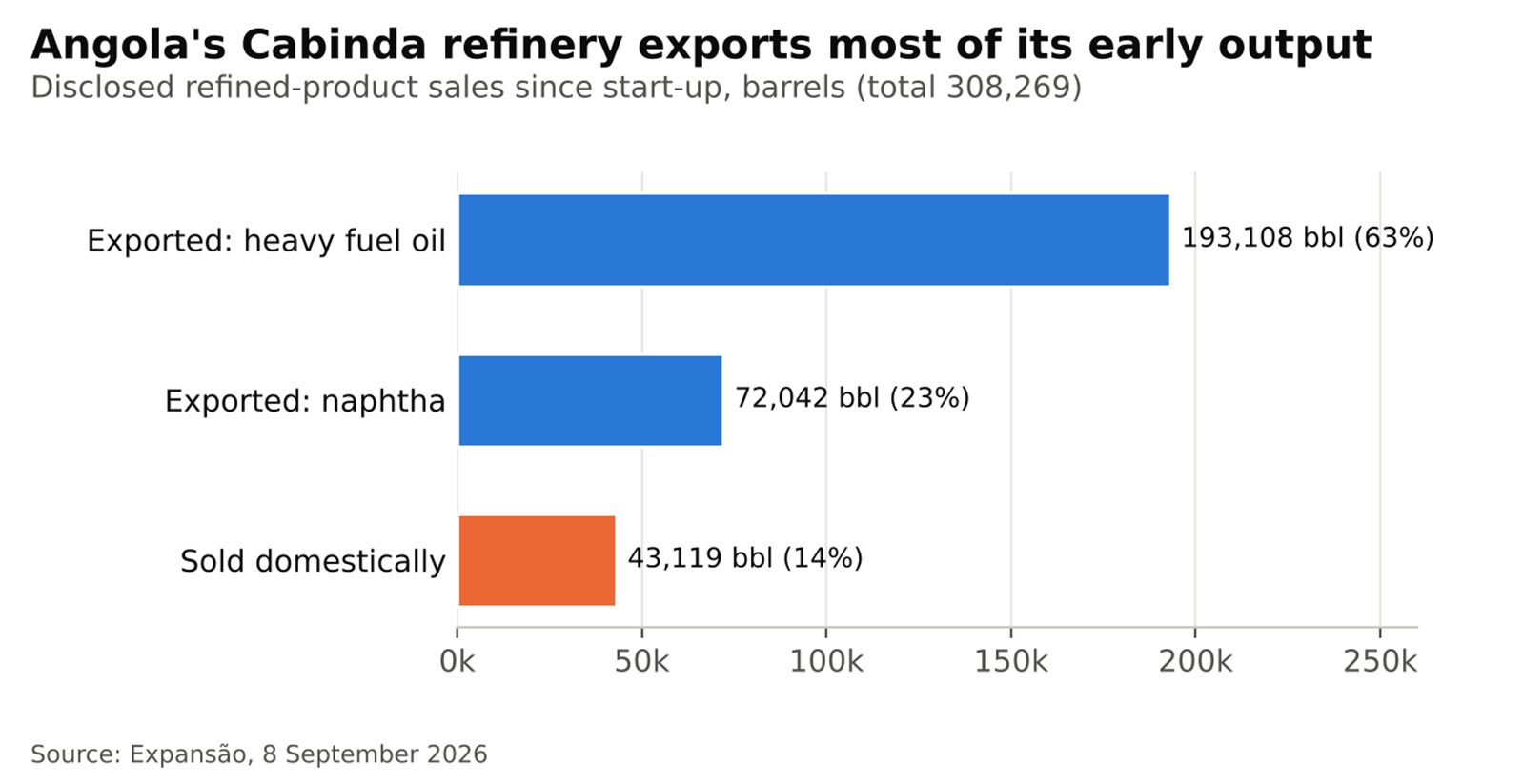
Angola has progressed further than most, with one refinery operating and another under construction. Its Cabinda refinery was inaugurated in September 2025 and began commercial operations in March 2026. The facility was processing approximately 15,750 bpd by August. However, about 86% of disclosed early refined-product sales were exported, mainly as naphtha and heavy fuel oil, rather than supplied to Angola’s domestic fuel market, IntelliNews reported.
The refinery’s first 30,000-bpd phase was budgeted at $473mn, although Gemcorp has said costs rose to $500mn-550mn. Majority owner Gemcorp is considering a second phase costing approximately $700mn to double capacity to 60,000 bpd, with technical studies scheduled for completion in November.
Angola’s larger 200,000-bpd Lobito refinery was approximately 26% complete in September, with $1.6bn already invested. Sonangol’s efforts to raise the remaining $4.8bn include talks with Chinese lenders, as IntelliNews reported.
Botswana, Namibia and Zambia have been invited to consider equity participation, although Sonangol intends to retain a controlling 51% stake. “We still have a lot of work to do in the development of the 200,000-bpd Lobito facility,” chairman Sebastião Martins said in September.
Namibia has cautioned that an invitation does not constitute an investment commitment. “An invitation to consider a proposal doesn’t necessarily mean a formal proposal has been received, let alone a decision has been made,” presidential spokesperson Jonas Mbambo told The Namibian in a report published on October 22. Energy analyst Gawie Kanjemba warned that minority investors would need to scrutinise valuations, financing terms and outstanding construction costs.
Elsewhere in Southern Africa, Zambia broke ground on a proposed 60,000-bpd refinery at Ndola in April, according to Oxford Economics. Angola’s planned 100,000-bpd Soyo refinery has yet to secure financing despite a contract award in 2021, while the first 80,000-bpd modular phase of Mozambique’s proposed 240,000-bpd refinery has made little progress since an EPC contract was awarded in July 2025.
State-owned refiners pursue restructuring and revival
In Cameroon, the government increased its direct stake in state refiner Sonara from 81.95% to 98.09% through a debt-for-equity recapitalisation disclosed in October. The restructuring involved a XAF381.12bn ($650mn) share issue that diluted TotalEnergies Marketing Afrique’s holding from 4% to 0.42%, without providing equivalent new cash for reconstruction.
Sonara subsequently signed a fuel supply agreement with Dangote and MRS Oil & Gas as its 42,000-bpd Limbe refinery remains shut following a 2019 fire. The government raised the estimated cost of rebuilding the plant to about XAF700bn ($1.24bn) in June.
South Africa’s Central Energy Fund has proposed rebuilding the former Sapref refinery at Durban, initially targeting 400,000 bpd and eventually up to 650,000 bpd. The CEF bought the 180,000-bpd plant, idle since 2022, from BP and Shell for a nominal ZAR1 in 2024. The investment is estimated at $7.15bn, with a final investment decision targeted for 2027/28 and preliminary financing discussions reportedly involving Afreximbank.
Any redevelopment must be “commercially disciplined, technically credible, and financially sustainable”, CEF chief executive Tshepo Mokoka said. Reviving Sapref and the mothballed Mossel Bay gas-to-liquids plant could require more than $8bn combined, according to Reuters.
However, Joan Swart questioned the commercial case for the proposed Sapref investment in a Business Day column, arguing that the estimated economic cost of lost refining capacity did not establish that building a substantially larger refinery would generate adequate returns. She advocated comparing the project with alternatives including strategic fuel reserves, import infrastructure and long-term supply contracts.
The South African Reserve Bank estimates that refinery closures have reduced petroleum-related manufacturing output by roughly 20% since 2019 and displaced approximately 5,400 direct and indirect jobs. Imported refined products now supply more than half the country’s fuel demand.
Nigeria’s state oil company NNPCL is separately assessing technical equity partnerships with Chinese companies Sanjiang Chemical and Xinganchen for its Port Harcourt and Warri refineries, under a memorandum of understanding signed in April. The companies have been carrying out site assessments, but definitive agreements and investment decisions remain outstanding. “Completing repairs alone is not enough; the facilities must also be able to operate reliably and profitably,” NNPCL spokesman Andy Odeh told Punch in October.
Refining margins face a longer-term squeeze
Industry research indicates substantial room for additional refining capacity. Consultancy CITAC estimates sub-Saharan African petroleum-product demand rose 6% to 121mn tonnes in 2025, while increased refinery output reduced import requirements by 7%. It forecasts demand reaching 186mn tonnes by 2045.
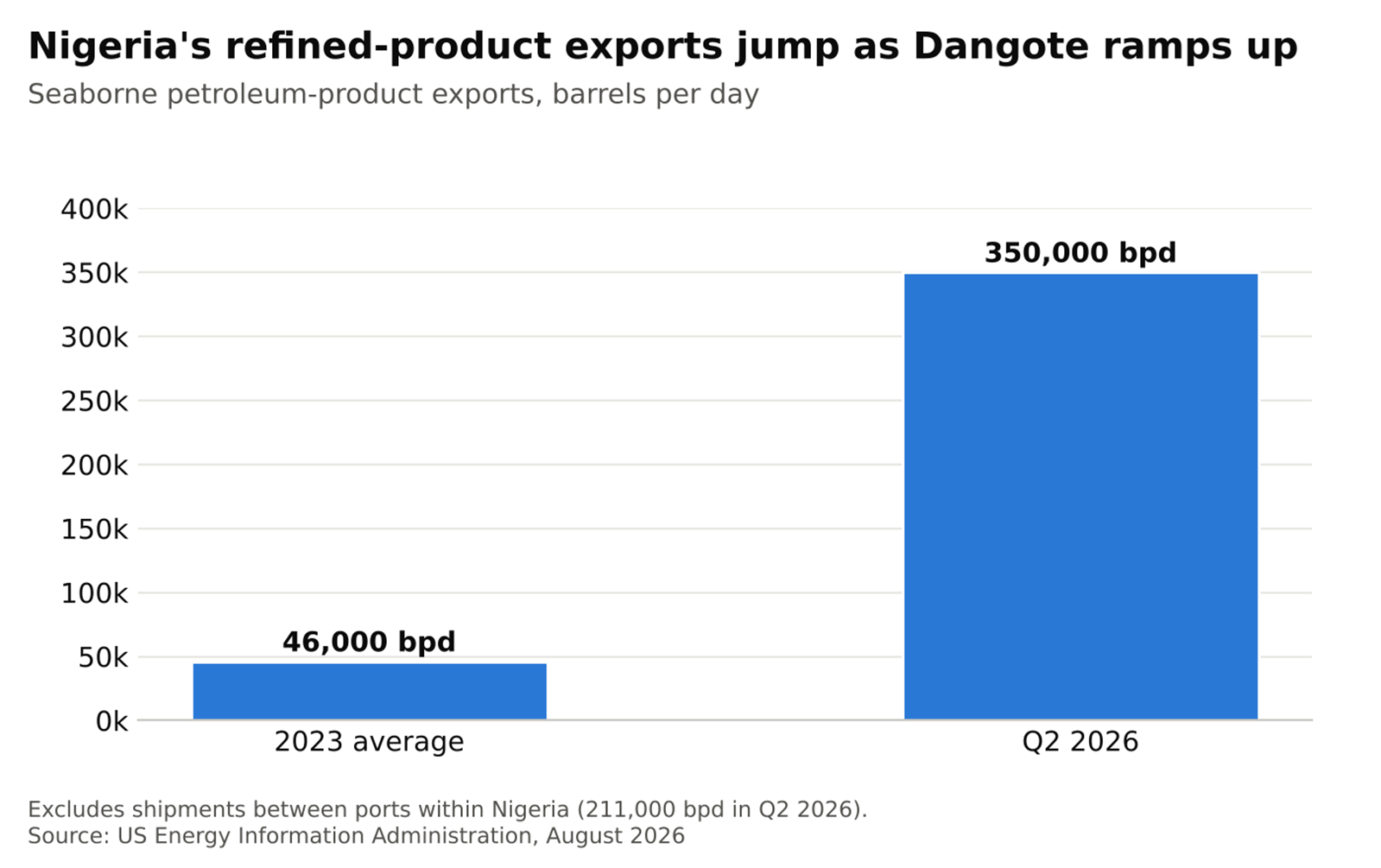
The US Energy Information Administration found that Nigeria’s seaborne petroleum-product exports averaged 350,000 bpd in the second quarter of 2026, excluding domestic coastal shipments, compared with an average of 46,000 bpd in 2023, reflecting Dangote’s expanding operations and disruption to Gulf product flows.
Abderrezak Benyoucef, head of OPEC’s energy studies department, said in October that Africa will require at least $125bn in refining investment through 2050, including new projects, existing facilities and maintenance. However, BloombergNEF’s latest global refining outlook forecasts 4.2mn bpd of net global capacity additions during 2026-2030, with Africa and Asia Pacific accounting for approximately 95% of the increase. BNEF warns that capacity growth could outpace demand, eroding margins, while projects scheduled for later in the decade face heightened risks of delay or cancellation.
Refining profitability could also deteriorate as the investment cycle matures. Oxford Economics projects average Brent crude prices falling from nearly $98 per barrel in 2026 to approximately $61 in 2030, while exceptional refining margins generated during the Middle East supply crisis are unlikely to persist.
Oxford Economics identifies timing as the biggest risk to Africa’s refining landscape, arguing that new facilities could begin commercial operations after the current period of unusually high margins has ended, although additional domestic refining capacity would still reduce reliance on imported products and strengthen resilience against supply disruptions.
See IntelliNews: Nigeria’s Dangote targets 1.4mn bpd by 2029 as $14.3bn expansion, IPO advance
See IntelliNews: Nigeria clears $1.6bn Dangote Refinery IPO, testing investor appetite at $47bn valuation
See IntelliNews: Botswana in talks to take 30% stake in Angola’s $6.6bn Lobito oil refinery
See IntelliNews: Ghana’s debt-laden oil refinery TOR faces $517mn burden amid IMF reclassifications
See IntelliNews: Uganda signs $4bn oil refinery deal with UAE’s Alpha MBM Investments
See IntelliNews: Nigeria’s NNPCL signs MoU with Chinese companies to revive refineries with equity partnership model
See IntelliNews: Can Chinese investors revive Nigeria’s troubled state-owned refineries
Follow us online