
Oil price spike at over $100 per barrel as market faces possibly worst crisis in history
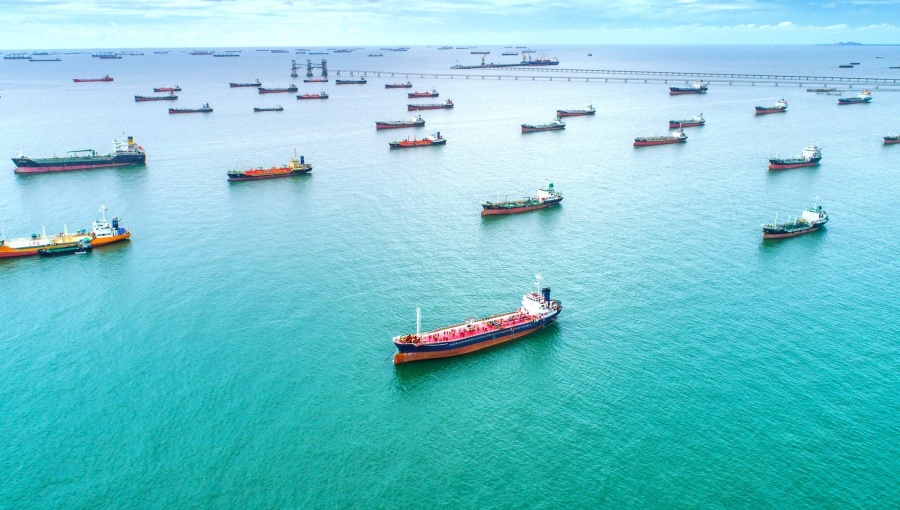
Oil prices surged to over $100 per barrel in early trading on March 9, as the Iranian blockade of the Strait of Hormuz for nearly a week now has led to production shut-ins across the Gulf as storage space for unexported oil runs out.
Brent was trading at over $108 per barrel as of 06:30 GMT, up from the early $90s at the close of trading on March 6 and the early $70s prior to the US and Israel launch of strikes against Iran on February 28.
As NewsBase warned, Gulf producers are now having to shut down wells because of limited oil storage capacity and limited alternative oil export routes to Hormuz, which typically handles 20mn barrels per day (bpd) of oil flow – equivalent to around a fifth of global supply.
Tehran claims it is only restricting passage through Hormuz for Western nations and Israel rather than completely closing the maritime chokepoint. But many other oil tankers are reluctant to pass through the Strait because of the risk of Iranian strikes – intentional or accidental. Iranian forces already targeted two tankers in the early days of the war.
Iraq has cut production from its southern fields that export via Hormuz by 70% to only 1.3mn bpd, Reuters reported on March 8, after the country’s storage facilities reached maximum capacity. Its exports also fell sharply to 800,000 bpd, from 3.33mn bpd in February, according to the news agency.
Kuwait and the UAE were next to announce production cuts over the weekend, with even larger producers like Saudi Arabia expected to take similar steps if the crisis is not resolved soon.
JPMorgan estimated on March 2 that onshore crude storage capacity across Gulf producers amounts to roughly 343mn barrels, equivalent to around 22 days of output that could become stranded if exports are unable to leave the region. In addition, about 60 empty tankers currently in the Gulf could provide temporary floating storage capacity of roughly 50mn barrels
“The market is shifting from pricing pure geopolitical risk to grappling with tangible operational disruption,” Natasha Kaneva, head of global commodities research at JPMorgan, told clients on March 6.
The bank estimates that production cuts could surpass 4mn bpd by the end of this week if Hormuz remains closed. The oil price surge may therefore have only just begun.
“Every additional day of disruption adds pressure, and in that scenario there is effectively no ceiling to prices in the short term,” Stefano Grasso, senior portfolio manager at Singapore-based fund 8VantEdge, told Bloomberg.
Depending on how it lasts, this may prove to be the biggest disruption in oil markets in history. In comparison to the 20mn bpd of exports affected by the Hormuz blockade, the Iranian Revolution of 1978 only disrupted 5.6mn bpd of supply, while the Yom Kipper war of 1973 hit 4.4mn bpd of exports, the 1990 Iraq-Kuwait war 4.3mn bpd and the Iran-Iraq war of 1980 some 4.0mn bpd.
As noted, the alternative export routes for Saudi Arabia and other producers is limited. As NewsBase has reported, Saudi Arabia possesses the greatest logistical flexibility. Its primary contingency relies on the East-West pipeline, which has around 2mn bpd of spare capacity to deliver oil to the Red Sea. But that would still leave 4mn bpd of Saudi exports trapped.
Other major producers face significantly shorter timelines. Kuwait lacks any bypass infrastructure, meaning all its exports must transit Hormuz. With limited storage headroom, Wood Mackenzie estimates the country has roughly two weeks of cover before it must slash production. Southern Iraq is similarly exposed; its 3.5mn bpd of exports are entirely dependent on the strait, with storage cover measured in “days, not weeks,” according to Araman.
The UAE maintains partial flexibility through the Abu Dhabi oil pipeline, which can move 1.8mn bpd to Fujairah, a terminal located outside the strait. Nevertheless, with total exports exceeding 3.4mn bpd, a substantial volume remains bottlenecked. Araman wrote that ADNOC’s Fujairah storage provides a buffer of roughly two to three weeks, after which Murban crude output must adjust.
The $100-per-barrel oil price is perceived as a psychologically significant threshold that when surpassed, could trigger problems for the global economy as well as inflationary pressure. Depending on the duration of Hormuz’s closure, the crisis could erase completely the surplus of global oil supply this year that was anticipated prior to the war. In February, the International Energy Agency (IEA) predicted that global oil production would rise by 2.4mn bpd in 2026, while demand would only grow by 850,000-930,000 bpd, creating a surplus of 1.47-1.55mn bpd.
Follow us online